On November 7, 2024, at a Sotheby’s digital art auction in London, an artwork conceived and executed by a humanoid robot crossed the auction block for the first time in history, realizing $1,084,800. The lot—a towering seven-foot mixed-media canvas depicting British mathematician, cryptanalyst, and computing pioneer Alan Turing titled A.I. God—decisively shattered its modest $120,000–$180,000 pre-sale estimate following competitive bidding.
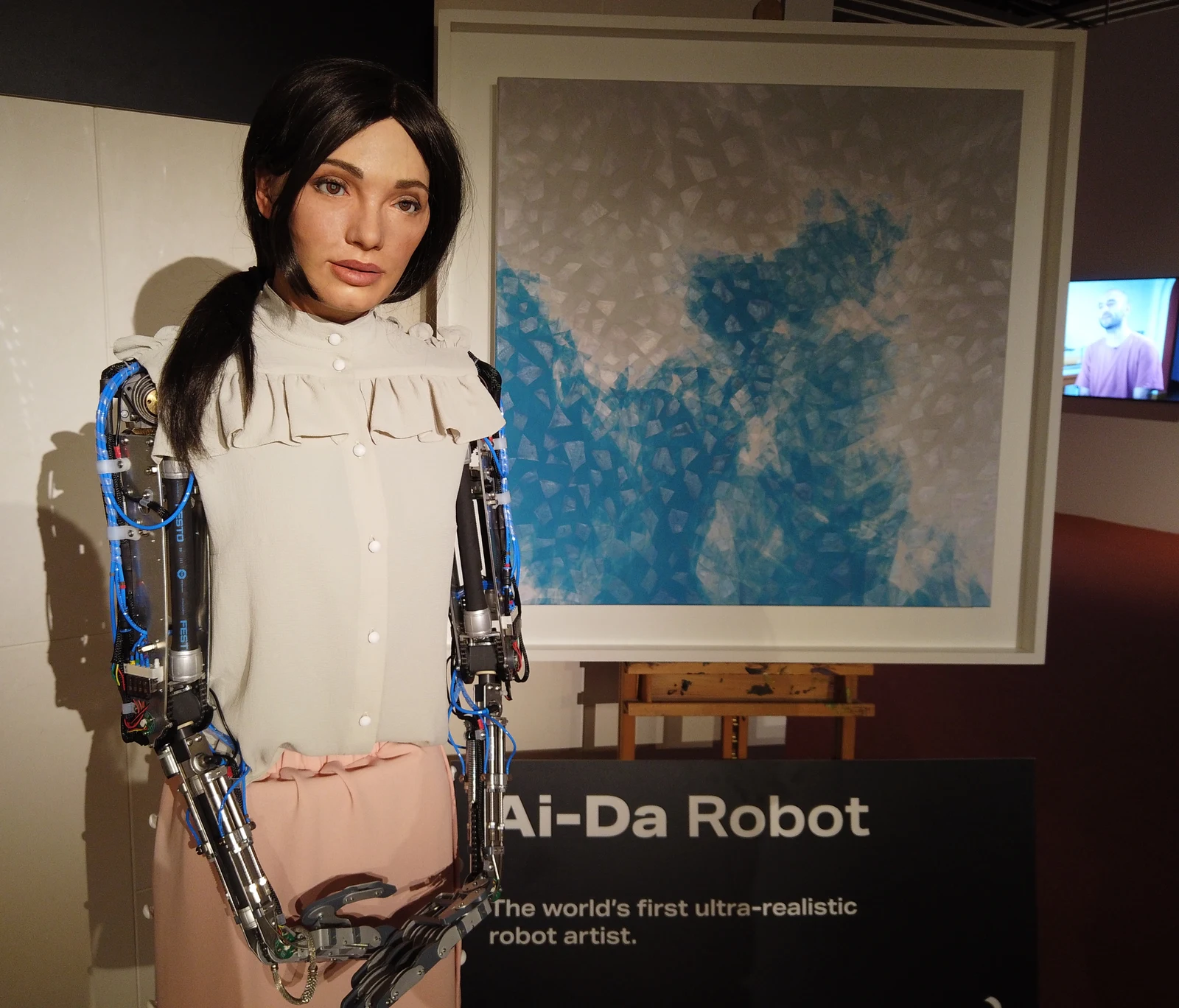
Ai-Da was devised in 2019 by British gallerist Aidan Meller in collaboration with roboticists and AI researchers at the University of Oxford. Named after pioneering Victorian mathematician Ada Lovelace, the humanoid robot features cameras embedded within its ocular sockets, complex artificial neural networks, and articulated bionic arms equipped with drawing and painting implements. A.I. God originally debuted in May 2024 at the United Nations 'AI for Good' summit in Geneva as part of a polyptych exploring ethics in automation.
The authorship question in robot portraiture
This million-dollar transaction prompts urgent philosophical questions for contemporary depiction. The first concerns authorship: who actually painted this picture? Decisions regarding thematic direction, palettes, and compositional prompts were deliberated through linguistic exchanges between Ai-Da and Meller’s studio team. The robot then plotted marks upon canvas, which human studio assistants occasionally glazed. While the Sotheby's catalog credited 'Ai-Da Robot,' authorship is radically atomized across human directors, software engineers, and automated bionic limbs.
The second dilemma addresses the ontology of portraiture. Classically, portraiture entails an intersubjective encounter—a mutual gaze shared between artist and living sitter. Turing died by cyanide poisoning in 1954; Ai-Da reconstituted his likeness from archival photography. While painting from photographs has been standard since the nineteenth century, here the eye looking at the photograph is a digital optical sensor, and the interpreting mind is a neural net. The foundational gaze of portraiture is here evacuated: it unfolds entirely between two optical machines.
The third dimension is historical irony. In his seminal 1950 paper Computing Machinery and Intelligence, Turing proposed what is now known as the Turing Test: determining whether a machine's behavioral output can be indistinguishable from human consciousness. A.I. God can be read as a financial iteration of the Turing Test: the contemporary art market proved willing to accord an automated artifact the monetary prestige typically reserved for elite human mastery.
Whether this sale heralds an enduring aesthetic paradigm shift or represents a temporary speculative novelty remains contested. What is undeniable is that the portrait of Alan Turing has forced the art world to confront the unraveling boundary between human artistic subjectivity and technological automation.