Digital animation. 4 works. 2021.
I often wonder how much of the proximity and distance we inherit from art history is actually our own. Where we are born, which culture we are considered part of, which language we speak, or which religious tradition we grow up within often determines, long before we make the choice ourselves, which artists we are expected to feel connected to. The idea that Michelangelo cannot be part of my artistic ancestry, that being born in another geography necessarily places me at a distance from his history and legacy, can become so deeply repeated that it eventually begins to feel self-evident.
Yet cultural proximity is not something we are born with. It is taught, classified, and repeated. Sometimes as tangible as a border, sometimes as invisible as a mental habit, these distinctions gradually begin to behave as though they were properties of reality itself.
My Orientalism Is Better Than Yours does not attempt to argue with these assumptions directly. Instead, it makes them slightly absurd. The series takes familiar political figures and established cultural stereotypes and places them within the repetitive gestures of Orientalist dance. Heads, bodies, and hips move continuously from side to side. The movement recalls both the stylised head and neck movements of belly dancing and the pendulum of an old clock. A bodily and cultural gesture meets a mechanical image of time within the same simple motion.
Part of the humour comes from this repetition. The characters change, the costumes change, and the political and cultural meanings they carry change, but the movement does not. History appears to move forward while the same gesture keeps returning. This tension between apparent change and repetition forms one of the central ironies of the series.
The costumes create another layer of this game. They do not simply explain or identify the characters. Instead, they create unexpected encounters between a figure and a cultural image. Macron appears in the dance costume of the Sun King; Biden wears a Native American feather alongside a cowboy outfit. I also enter the scene as an artist from Istanbul, dressed as a Janissary. These costumes are therefore less illustrations of identity than interventions into it. What we choose to place on a figure can reveal not only something about that figure, but also where we are looking from.
These unexpected combinations expose how easily cultural images can be displaced. A costume can be removed from its historical context and placed upon another body; a stereotype can be made to circulate through an entirely different figure. Cultural identities consequently begin to appear less as fixed and natural categories than as visual constructions that are continually being rearranged.
One of the important aspects of the series is the way it redirects the gaze. I look at the West from the East, but I do not simply turn my head towards the West. Rather than reversing the gaze, I extend its movement and approach it from behind. I take the Orientalist gaze directed towards the East, follow it beyond its own trajectory, and return it towards the West. The question therefore becomes more than who represents whom. The manner in which representation itself is produced becomes part of the work.
The humour of the series is consequently not simply directed at political figures. It reveals how easily cultural categories can be constructed and how natural they can begin to appear through repetition. The idea that one figure is “Western” and another “Eastern”, that one person is naturally closer to a particular cultural history while another is inherently distant from it, eventually becomes a mechanical gesture repeating itself over and over again.
Perhaps this is where the series’ simplest and most persistent movement acquires its meaning: to the right, to the left; right again, left again. Like a clock. Like a dance. A movement that appears to change, yet always returns to where it began.
My Orientalism Is Better Than Yours is therefore not simply a parody of the Western gaze from an Eastern perspective. More broadly, it plays with the classifications that tell us who we are and to whom we are supposed to be close or distant. In a world where what is accepted can gradually replace what is real, and where repetition can begin to resemble truth, perhaps one way of disrupting the system is to take it just seriously enough for it to reveal its own absurdity.
My orientalism is better than yours /2/ Dance of Macron
My orientalism is better than yours /3/ Dance of Biden
My orientalism is better than yours /4/ Dance of the Artist as Janissary
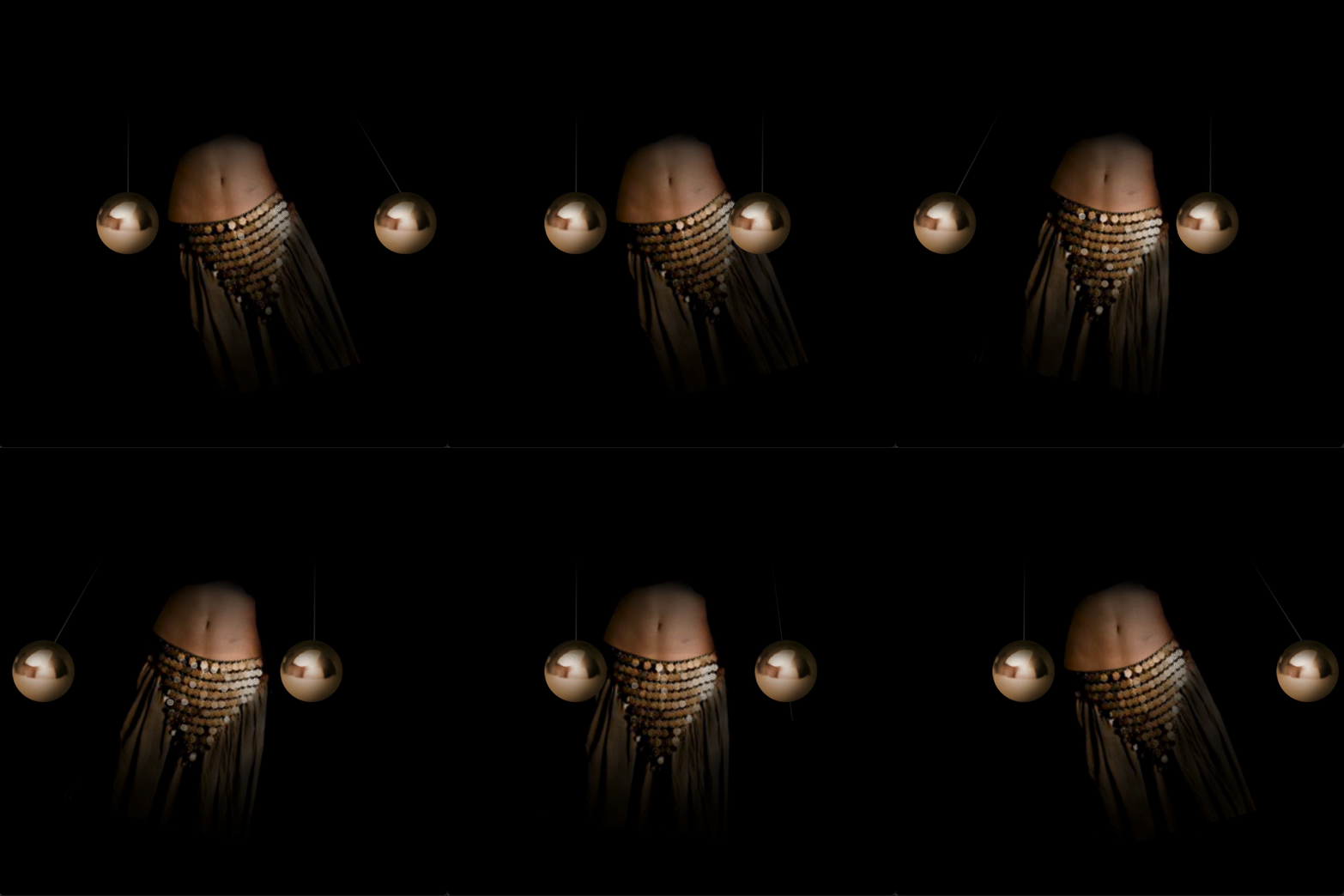
My orientalism is better than yours /1/1Belly Dance