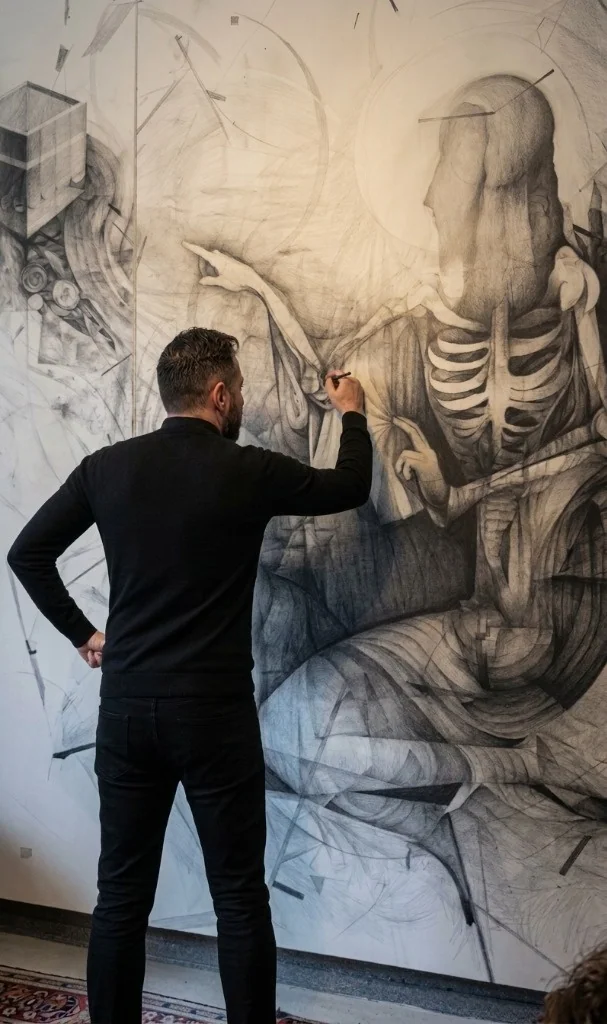
Ongoing series. Charcoal and plant-based yellow pigment on various surfaces. 30×50 cm to 300×300 cm.
Over the years, I have noticed that certain colours, forms, and materials return to my work again and again. Yellow and black are among the most persistent. For me, these two colours have become less a consciously chosen palette than a familiar point of departure, a place from which I return to painting.
In these works, I create the black primarily with graphite, pencil, and 0.5 and 0.7 mm mechanical pencil leads in different degrees of hardness. The yellow is made using a traditional method I learned from my mother. Various wild plants and onion skins are boiled to produce a transparent yellow pigment. When it encounters the lines and tones of the pencil, the result is more than a contrast between two colours. As the different characters of the two materials approach one another on the surface, a shifting relationship emerges between line and stain, opacity and transparency. What begins as an encounter on paper sometimes acquires a different physical intensity in paintings that expand to monumental dimensions.
Much of what yellow and black carry for me comes from childhood memory. I grew up looking at my older brothers’ black-and-white drawings. Picture books, the yellowed pages of old books, the dark lines of woodblock prints, and the pigments my mother prepared at home gradually became part of my visual memory, without my being fully aware of it at the time. Working with these two colours today is therefore not simply an aesthetic choice. It is also a return to a visual world carried from the past into the present.
One encounter holds a particular place within this memory: the paintings of Mehmed Siyah Kalem, which I discovered as a child in Istanbul’s Sahaflar Çarşısı. What affected me was not only the force of the line. I was deeply struck by how easily the boundaries between human and animal, reality and imagination, the familiar and the uncanny could shift within those images. I cannot fully explain how that early experience finds its way into my paintings today. But I believe that some encounters continue to work within memory without ever needing to be fully explained.
Over time, my relationship with yellow and black has led me beyond my own past, towards the history of images shaped around light, darkness, transformation, and nature across different cultures. I am less interested in representing a particular tradition or making direct references to it than in following certain recurring sensibilities across time. Images in which the boundary between human and nature becomes uncertain, or darkness is understood not simply as absence but as a space of transformation, occasionally reappear in the background of my work.
For this reason, I do not see yellow and black simply as opposites of light and darkness. They also function as two poles through which movement takes place between what is visible and what remains concealed, between formation and dissolution, between memory and the present. They oppose one another, but they also bring one another into being. Black makes the luminosity of yellow more pronounced, while yellow alters the density of black and makes the structure of the line visible in a different way.
The strong response these works have received from viewers and collectors over the years is meaningful to me. But it is not what keeps me returning to them. There is a more personal, and more difficult to define, reason for my continued return to yellow and black. Each time I think I have arrived at the same place, I realise that both the painting and I have changed. The same two colours begin to say something different at different moments.
Perhaps this is why yellow–black is not a style for me. It is a threshold through which I return to painting. An open field in which I begin, each time, from the same place with the possibility of arriving somewhere else, where personal memory, material, and the history of painting begin to overlap.
Seen up close, these paintings carry the stories not only of their colours, but also of the line, the pigment, and the surface. The pressure, repetition, and density of the pencil meet the transparency of the plant-based pigment, creating different layers of time across the surface. To stand before these works is therefore to encounter not only the image that has emerged, but also something of the process through which that image has come into being.
These paintings moving between yellow and black are still not the result of a completed idea. They remain, rather, an open space I return to through painting, again and again.
These works are best experienced in person. Contact for availability and dimensions.