A figure holding a bird in one hand repeats across a woven silk textile. On another historical object, two individuals meet near a blossoming tree. Both artifacts reside within the Department of Islamic Art at The Metropolitan Museum of Art. This modest visual encounter suffices to halt a widespread, sweeping generalization. In discussing the visual culture of the Islamic world, can we legitimately collapse every figure, every decorative object, and every historical epoch into a singular, monolithic conception of representation?
In my ongoing research into the human face, identity, and the boundaries of recording presence, the philosophical relationship between likeness (suret) and representation (tasvir) forms an essential domain. Rendering a face visible upon canvas does not mean the fullness of that human existence has been transferred to the pictorial plane. Historical visual debates can profoundly enrich this contemporary question—provided we respect history's own internal distinctions.
Aniconism, in its broadest scholarly definition, designates the deliberate avoidance of figural depiction within specific socio-religious contexts, or the intentional turning toward non-figural modes of representation such as calligraphy and geometry. When deploying this term, precision regarding community, era, architectural space, and medium is essential. Evaluating an imperial textile through the spatial criteria of a prayer hall erases the very distinctions that scholarship seeks to understand.
What Question Does the Absence of the Image Open?
Facing a surface devoid of figuration, our first task is to observe what is positively present. Inscriptive calligraphy, geometric interlace, botanical arabesques, material texture, and rhythmic repetition articulate how the surface is constructed. The absence of the human figure does not indicate that the surface is mute. Rather, it demands recognizing that visual attention has been deliberately redirected toward other metaphysical and spatial relations.
Yet observing that a figure is absent and knowing why it was omitted are separated by a significant methodological distance. When an object is encountered solely through photographic reproduction, we may lack crucial documentation concerning its patron, original spatial setting, or ritual use. Explaining every absence through an all-encompassing theological ban prematurely completes an archival silence.
The Met's curatorial essay on figural representation in Islamic art highlights the fundamental distinction between sacred religious architecture and secular, courtly, or domestic environments, documenting the vibrant presence of human and animal forms across ceramics, manuscripts, and textiles. This nuanced framework cautions against flattening an expansive visual tradition into a single formula, encouraging us instead to interrogate object typology and social function. The Met, Figural Representation in Islamic Art
This distinction represents far more than academic taxonomy. It reminds us that two formally identical visual motifs can possess radically divergent meanings across different social arenas. Once the existence of an image is identified, we must ask how it was engaged: Was it read in solitude, worn as ceremonial vestment, handled in daily life, or encountered within sacred liturgy? These verbs of interaction are as critical as the iconography itself.
Why Must Aniconism and Iconoclasm Be Kept Distinct?
The deliberate choice not to execute a figural depiction and the active physical destruction of an existing image are fundamentally distinct events. Iconoclasm designates the ideological, religious, or political destruction, defacement, or suppression of images. The Met's scholarly analysis of Byzantine iconoclasm clarifies the term within this precise historical matrix. The Met, Icons and Iconoclasm in Byzantium
In the former instance, we analyze choices of artistic fabrication and social utility; in the latter, we confront hostile interventions directed against a pre-existing object. Who performed the intervention, at what historical juncture, and under which political rationale must be documented through material evidence. Surface abrasion, breakage, or loss of pigment cannot be assumed to be intentional censorship without archival corroboration.
Idolatry can likewise not be conflated with these terms. Here, the critical problem is not merely the optical existence of a figure, but the devotional relationship of worship forged with the image. The presence of a human form upon a functional vessel does not imply that the object was revered as a cult idol. Deriving theological devotion directly from formal appearance in the absence of functional context produces profound historical distortions.
Preserving these distinctions does not downplay historical friction. On the contrary, it illuminates precisely where ideological contests transpired. When analytical concepts are stretched too broadly, every historical artifact is reduced to an interchangeable illustration of a single thesis. Yet genuine historical objects frequently resist overarching narratives, and it is precisely this productive resistance that drives research forward.
Two Figures on Silk
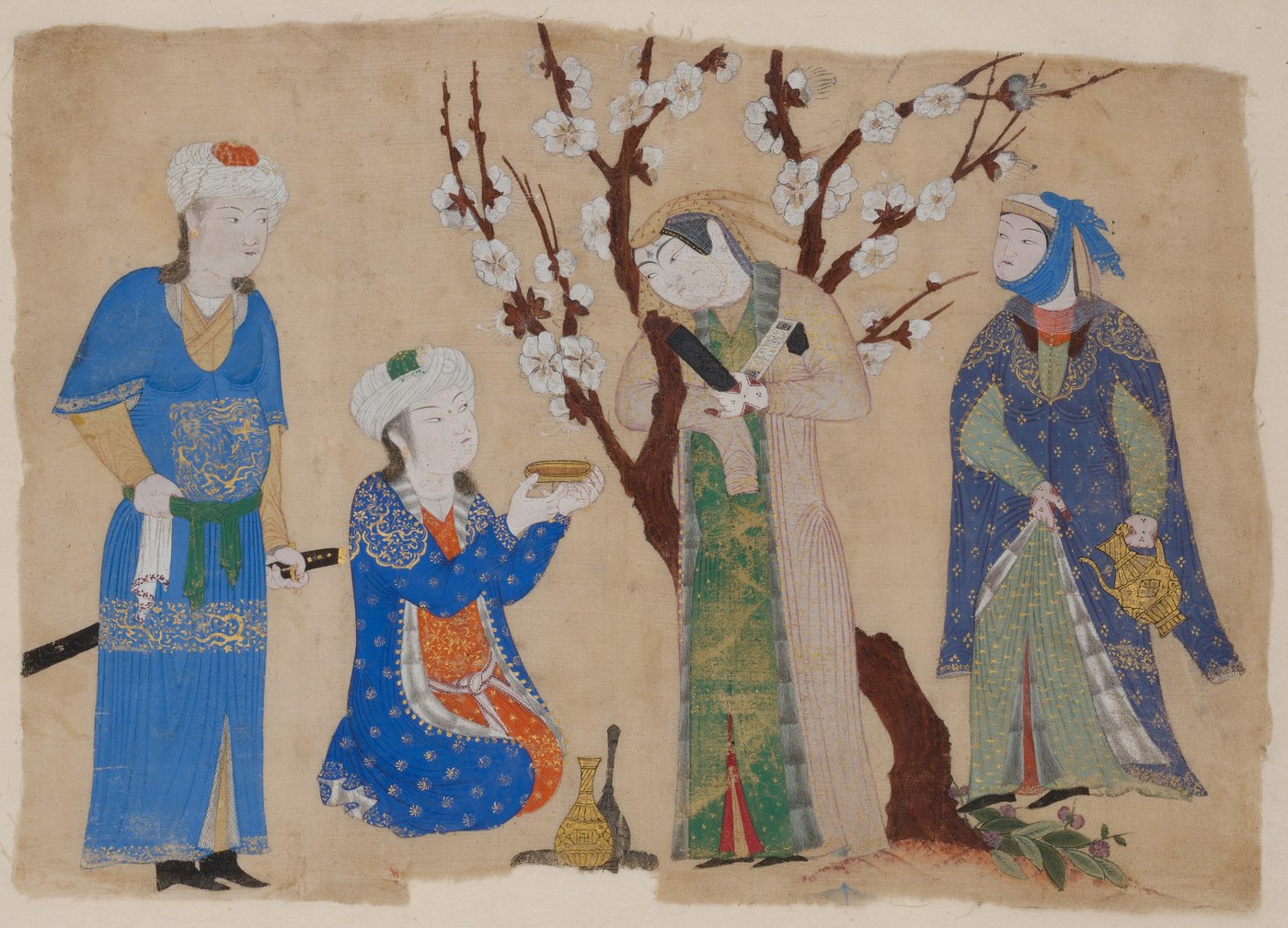
The Met's catalogue dates Wine Drinking in a Spring Garden to approximately 1430, attributing it to Tabriz, Iran. Executed with opaque watercolor and gold upon undyed silk, the museum associates the ceremonial presentation of wine with an idealized courtly ethos celebrated across Persian lyric poetry and painting. Attributions and date ranges in museum records must always be read alongside their noted degrees of scholarly certainty. Accession record, 57.51.24
One inquiry we can direct toward this delicate painting is the relational matrix within which the figure appears. Depicting an isolated individual for biometric identification is fundamentally different from portraying two sitters engaged in poetic gesture before a flowering bough. The garment, the cup, the physical proximity, and the negative space participate in constructing this visual narrative.
Rather than extracting the worldview of an entire epoch from a single artifact, we proceed on firmer ground: in this specific production, the human form was integral to constructing an idealized visual scene. From this evidence, scholarship can explore courtly patronage, poetic metaphor, and workshop circulation. However, these complex histories cannot be known merely from looking at the figure in isolation.
In art-historical analysis, a proliferation of questions is not failure. Often, dissolving an unexamined generalization marks the true beginning of engaging with an artwork. Once an object is disentangled from sweeping classifications, its unique formal nuances become visible.
The Repeated Human in Woven Textile
A second illuminating artifact is a mid-16th-century Persian velvet, Velvet with Figural Imagery, attributed to Safavid Iran. Museum records identify the medallion scenes as falconry pursuits, woven with silk and metal-wrapped threads (Accession: 52.20.11). The Met, Collection record
Here, the human figure is incorporated into the rhythmic repeat pattern of a luxurious woven textile. We do not ask the same questions of this fabric that we would address to an autonomous Renaissance portrait designed to preserve the unique individuality of a patron. We examine first how the figures populate the surface, and how pattern repetition choreographs the eye. The human form functions simultaneously as narrative iconography and structural ornamental motif.
Juxtaposing this velvet with the silk painting does not imply that one artifact explains the other. Their substrates, scales, and utilitarian lives are disparate. The value of the comparison lies in demonstrating that figural representation in Islamic art cannot be reduced to a singular formula. The human silhouette undertakes varied aesthetic duties across divergent material orders.
A museum vitrine is rarely the original setting for which such artifacts were designed. That we encounter them today under modern museum lighting does not grant us unmediated access to their historical reception. Studying catalogue entries bridges this distance without entirely collapsing it. Alongside the visual motif, its physical circulation and ritual use must be interrogated.
From Likeness to the Truth of the Human
Having situated these historical artifacts within their material contexts, we can transition to a contemporary question of representation: What is the relationship between the visibility of a face and the profound comprehension of that human being? This question cannot be retroactively imposed as the secret doctrine of historical weavers; rather, it represents a contemporary philosophical inquiry informed by historical encounters.
The terms suret (external likeness) and tasvir (pictorial figuration) frequently overlap in ordinary speech. In this text, I employ suret to indicate the visible, measurable form of a person, and tasvir to designate the deliberate aesthetic construction of that form within an image. This operational usage does not claim to exhaust the rich theological and philosophical lineages of the terms.
In my research, the critical distance between the quantifiable metrics of a face and the irreducibility of lived experience remains central. An optical scan can successfully register a face. However, concluding that the resulting digital record encompasses the entirety of a person's memory, grief, fatigue, and vulnerability is an illegitimate leap. Representation operates through selected criteria; the unmeasured excess of human life continues beyond the frame.
For this reason, I do not read past aniconic debates as direct historical ancestors of contemporary biometric resistance. The intellectual connection between them lies not in claiming identity, but in recognizing that different historical conditions granted the image different degrees of authority. Interrogating the authority attributed to the image exposes profound divergences as well as provocative parallels.
Looking Anew at the Face
In my figurative paintings, as I investigate the human face and the boundaries of representation, the philosophical reflections on suret and tasvir emerging from my cultural geography remain an active presence. This relationship cannot be described as merely reproducing historical formulas. A contemporary painting confronts the questions inherited from the past directly within today's hyper-mediated technological landscape.
Painting a face does not demand claiming total ownership over its meaning. A painting can slow the cadence of looking, compelling us to pause before a presence we presumed we instantly recognized. Whether this deceleration actually transpires must be verified before the canvas itself, within its material surface and the encounter it establishes with the spectator.
The critical horizon opened by contemplating aniconism extends far beyond tallying whether a figure is present or absent. It challenges us to examine how much authority we delegate to an image, what expectations we burden it with, and across which socio-political frameworks we interpret it. At what historical juncture do we permit a visual representation to usurp the living human being?
Returning to the scene upon silk and the repeating figures on velvet, we no longer see mere silhouettes. The distances separating dating, materiality, function, and interpretation become integral to the gaze. The face remains visible—as does the humbling boundary of everything we can legitimately claim to know about it.