On June 12, the Metropolitan Museum of Art in New York opened its major exhibition Orientalism: Between Fact and Fantasy. This marks the museum's first exhibition dedicated to Orientalism and will remain on view through February 28, 2027. A massive endeavor comprising approximately 180 works, congratulations are due to everyone who contributed.
For the first time, Osman Hamdi Bey shares the narrative stage alongside Gérôme and his contemporaries in an exhibition of this scale and at such a prominent institution, effectively positioned as one of the show's stars. In Turkey, news of this exhibition was naturally received with enthusiasm. I too am thrilled to see Hamdi at the Met. Yet almost every article I have read repeats the same premise: that Hamdi did not imagine the East from the outside, but painted it from within. It is this premise that I wish to challenge. Let us unpack it.
What the Met Says
Unable to travel to the United States to visit the exhibition in person, I must rely on the published discourse. The first port of call is the Met's own exhibition website. Here, the section devoted to Hamdi is titled "Osman Hamdi Bey: Depicting the Orient as an Insider".
The section text essentially conveys two things. First, that Hamdi's compositions were produced primarily for a Western audience. Second, that these compositions are less laden with the clichés of European and American Orientalists, appearing "more authentic and personal." The text is cautiously phrased, using the word "appear." Yet this cautious nuance failed to translate into either foreign or domestic press coverage. In the Boston Globe's review, Gérôme represents the fantasy while Hamdi represents reality. The artist's ethnic origin is read as documentary evidence of the painting. Rather neat, is it not?
This discourse is not new. In 1999, Wendy Shaw interpreted Hamdi's paintings as works subverting the Orientalist gaze. In 2002, Zeynep Çelik similarly argued that he spoke back to Orientalist rhetoric. The Met's framing aligns closely with this tradition. On the opposing side stands Ottoman historian Edhem Eldem (and myself :)). For years, Eldem has scrutinized Hamdi's letters, exhibition records, contemporary reviews, and the Western sources of the paintings. In his view, such readings rely on no documentation other than the paintings themselves, projecting intentions onto Hamdi that he never held. None of Hamdi's contemporary European viewers noted any subversive counter-discourse; they praised his technical virtuosity and perceived authenticity. In this essay, I largely follow Eldem's footsteps.
Who Was Osman Hamdi Painting For?
Let us begin with a fundamental question: for whom were Osman Hamdi's paintings intended? As Eldem cites, the Vienna publication Neue Freie Presse noted in 1879 and 1880 that the majority of Hamdi's canvases were destined for Paris, Odessa, and London. Several were commissioned by a British collector (most likely William Henry Wrench, the British consul in Istanbul). The exhibition chronology confirms this pattern. Hamdi's exhibitions in Istanbul were confined to 1880, 1881, and 1882. Thereafter, his works were exhibited in Berlin, Paris, London, Munich, Chicago, and Liverpool. The Met's assertion that they were produced "for a Western audience" is thus entirely accurate. As far as historical records show, Hamdi painted almost exclusively for European patrons.
Two Separate Hamdis
For this reason, Osman Hamdi's oeuvre should be divided into two distinct groups. The first group comprises Orientalist scenes crafted for European buyers. In these paintings, every detail is authentic: the architectural backdrops, textiles, Iznik tiles, and oil lamps. The context, however, is entirely fictional, arranged precisely to satisfy Western expectations. Works such as his carpet sellers or young women reading belong to this group. The second group features Hamdi as a modernist painter: intimate family portraits, landscapes of Gebze and Eskihisar, and portraits of Ottoman figures and women of his own era. In my view, Hamdi's authentic painterly genius reveals itself most profoundly here. If I consider myself an admirer of Osman Hamdi today, it is largely owing to this second body of work.
Eldem draws the exact same boundary. In his analysis, Hamdi produced Orientalist scenes deemed "bon pour l'Occident" (good enough for the West) on one side, while executing portraits in a purely Western academic idiom on the other, never allowing the two realms to bleed into one another.
Which Hamdi is on view at the Met? The exhibition checklist includes seven paintings by Hamdi: two versions of At the Mosque Door (1879 and 1891), Excavations at the Temple-Palace of Nippur, Man Pondering the Quran, Dervish at the Tomb of a Child, Young Woman Reading, and the 1888 street scene known as Carpet Dealer in Turkey. Not a single portrait or landscape is included. The Nippur canvas stands somewhat apart due to its archaeological theme. All the remaining works belong strictly to the first group. The entire claim of an "insider perspective" rests squarely upon these staged, fictional compositions.
How the Fiction Operates
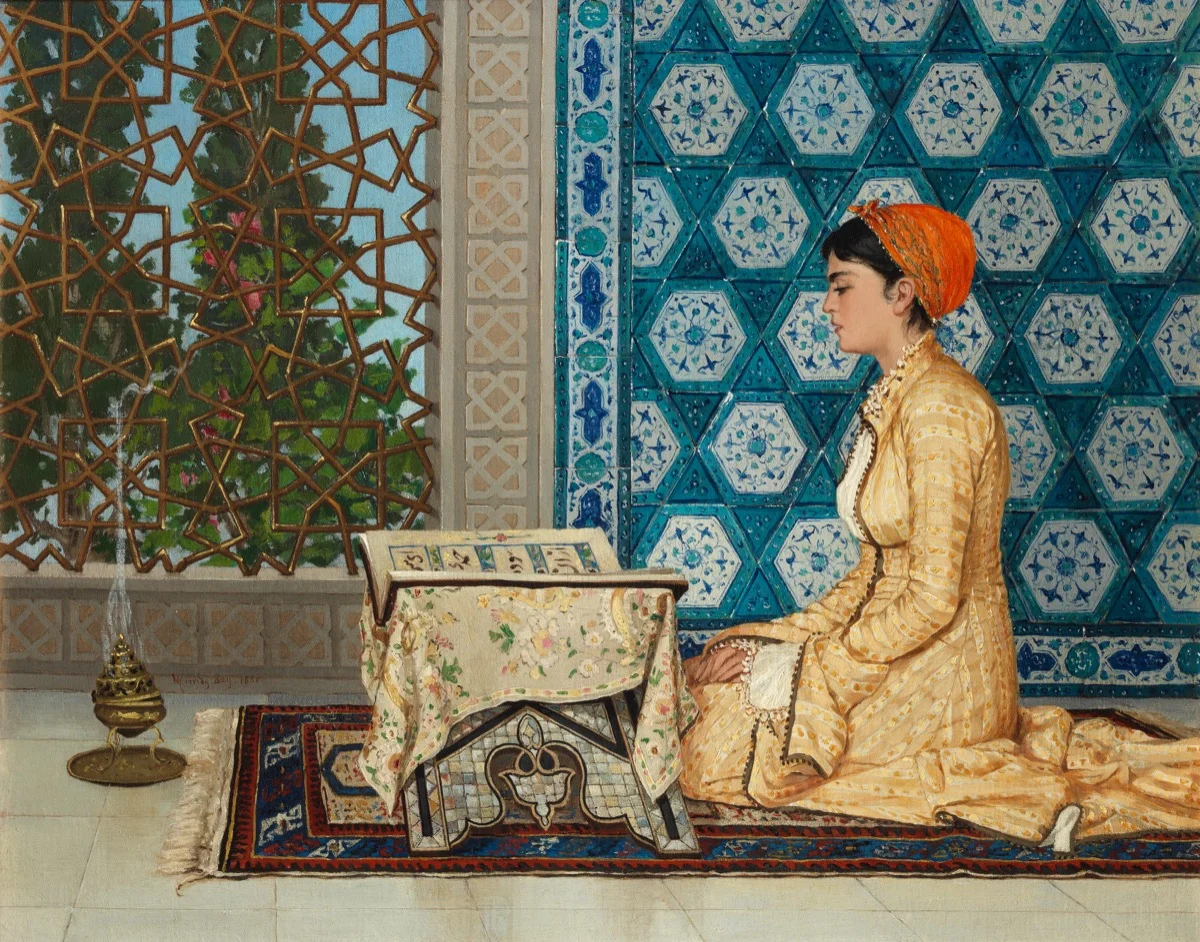
Consider Young Woman Reading (1880) in the exhibition. For many years, this painting was referred to as Young Woman Reading the Quran. Eldem demonstrates that this title was merely a descriptive label rather than one assigned by the artist himself. The painting was never exhibited during Hamdi's lifetime. The calligraphy on the book is in all likelihood decorative; on the second line, one can discern Hamdi's own signature. The hexagonal wall tiles in the background originate from the upper gallery of the Green Mosque in Bursa. The window lattice recurs verbatim in another of his paintings. The young woman's dress appears in other harem scenes. In Eldem's formulation, these paintings are "collages assembled from interchangeable, evocative fragments." They harbor no ambition toward documentary veracity.
At the Mosque Door operates through identical methods. In Dervish at the Tomb of a Child, a leopard skin lies on the floor inside the shrine. What is a leopard skin doing inside an Ottoman tomb? Eldem identifies this as one of the recurring Oriental curiosities Hamdi carried from canvas to canvas. Space, object, and figure are independently selected and juxtaposed.
A similar dynamic unfolds in The Carpet Dealer. Several carpets lie crumpled haphazardly on the ground. No merchant would ever display carpets in such a manner; it makes them both difficult to inspect and cumbersome to store. Moreover, in an open-air alleyway, a delicate porcelain vase sits inside a wall niche! :) Such calculated disarray lends a picturesque bazaar atmosphere to the scene, yet it contradicts the everyday reality of rug merchants. Eldem interprets the peeling plaster, cracked tiles, and frayed kilims in Hamdi's paintings as markers of distinctly Orientalist tropes: the representation of a frozen East sliding into picturesque decay.
How did this collage come to be embraced as authentic? I believe the answer lies in the signature. As Eldem observes, Hamdi's signature stamped even the most fictitious composition with an authoritative seal of authenticity. European viewers believed they were finally witnessing the authentic Orient through the eyes of an Eastern native. "He was not speaking back to Orientalism; he was surfing it" (Eldem, 2022). Hamdi was not pushing back against Orientalism; he was riding its crest.
How the Exhibition Was Read in Turkey
With this context established, let us return to Turkish press coverage. Most reports drew almost verbatim from two sources: the Met's official press release and the Pera Museum's announcement. Milliyet Sanat (August 5), Habertürk, İstanbul.net, and Türkiye Today (July 30) reported nearly identical phrasing: that seven canvases painted between 1879 and 1903 were featured. Euronews Turkish (May 20), Daily Sabah (June 5), and Artkolik (June 15) uncritically echoed the Met's "insider" framing. In none of these articles did I encounter the cautionary qualifications present in the Met's own text, namely "for a Western audience" and "appear".
I do not know who authored the Milliyet Sanat report, but it contains an intriguing contradiction. Describing the Pera Museum's collection, the article notes that Hamdi constructed his scenes by drawing upon architectural details, historical artifacts, garments, and photographs. It also differentiates his family portraits and landscapes of Gebze and Eskihisar as the artist's more personal, unconstrained works. Both the collage technique and the two distinct production spheres are acknowledged within the very same article. Yet the report somehow juxtaposes these facts with the Met's "insider gaze" rhetoric without questioning the inherent tension.
The article published in ArtDog İstanbul (Şebnem Kırmacı, October 13) represents the most extensive and attentive commentary on the subject, and warrants closer examination. The essay interprets the exhibition, which places Hamdi within the same narrative as Gérôme, as a gesture demonstrating that Orientalism was not a unidirectional gaze. It characterizes Gérôme's Ottoman world as a staged, dramatized, and exoticized tableau constructed for the Western spectator, a diagnosis with which I wholeheartedly agree. Kırmacı's criterion is sharp: is a scene constructed through the artist's firsthand observation, or to meet the expectations of Western collectors? While this question is posed for Gérôme, it is never raised regarding Hamdi's Western-market canvases. Hamdi is instead described as painting the East "from within the world he lived in." Discussing At the Mosque Door, the essay notes that architectural motifs, clothing, figures, and daily life converge on the same surface. As we have seen, that surface is the very locus where the fiction is fabricated.
Citing the Met's assessment, the article further claims that Hamdi produced an insider response to the exotic tropes of Western Orientalists. Yet the Met's text merely states that his compositions "appear more authentic." The vital distinction between a deliberate political response and an aesthetic appearance seems blurred in the review.
To be fair, Kırmacı does not leave the piece one-sided. She notes that the exhibition is neither flawless nor beyond debate, acknowledging that certain critics have too readily cast Hamdi as the authentic voice of the East. Her observation that Hamdi first learned to view the East through Western eyes also aligns with Eldem. The divergence emerges in the conclusion. Kırmacı interprets this learned gaze as a critical reply to Western fantasy; Eldem interprets the same gaze as a commercial formula perfected for Western patrons. The essay concludes with the statement that looking at the East and looking from the East are not the same thing. To this, I would add: someone looking from the East can also construct the exact East that the West wishes to see.
Originating from the East
Originating from the East does not preclude an artist from producing Orientalist art, a reality of which we are all well aware. Hamdi was an insider by origin, but in the paintings he made for the West, he calibrated his gaze to match that of the Western buyer. We may call this an internal Orientalism, but we cannot describe it as an insider counter-gaze opposing Orientalism, least of all on the evidence of the works gathered at the Met.
Hamdi's Orientalism certainly differed from Gérôme's. He steered clear of explicit violence and eroticism, depicting women fully clothed and composed. Yet a restrained Orientalism remains Orientalism nonetheless.
The core issue does not lie within the Met's curatorial wall text. The Met states clearly that Hamdi worked for a Western audience and that his works appear more authentic. The issue lies in the chasm between that cautious phrasing and the uncritical deployment of the word "insider" in exhibition headlines, media coverage, and Turkish commentaries. An exhibition conceived with good intentions risks perpetuating the oldest Orientalist reflex by placing Hamdi on the side of "reality", mistaking the artist's ethnic identity for documentary truth. Hamdi's paintings for the West are deliberate fictions, and a fiction does not cease to be a fiction merely because its author is Eastern.
Recognizing this does not diminish Hamdi nor reduce his artistic value. On the contrary, it invites us to encounter him from a far more nuanced vantage point. In that second group of works, where he painted the Ottomans of his own day, his family, and the tranquil shores of Eskihisar, Hamdi was indeed looking from within. That the Met's selection does not include a single work from this personal sphere strikes me as the exhibition's most conspicuous omission.
The exhibition Orientalism: Between Fact and Fantasy is on view at the Metropolitan Museum of Art from June 12, 2026 to February 28, 2027.
Met exhibition website: https://www.metmuseum.org/exhibitions/orientalism-between-fact-and-fantasy
ArtDog İstanbul, Şebnem Kırmacı (13 October 2026): https://artdogistanbul.com/doguya-bakmak-dogudan-bakmak/