The historiography of Turkish art continues to bear the deep imprint of the early twentieth-century nation-building project. In early Republican narratives, the Ottoman past was either cast as a feudal threshold to be overcome or assimilated strictly into an ethno-religious framework. Consequently, whenever "Ottoman art" or the lineage of Turkish visual culture is invoked, scholarly and public discourse has largely gravitated toward the imperial mosques, mausoleums, madrasas, calligraphy, and court miniatures patronized by the Muslim ruling elite.
Yet the Ottoman world was an inherently polyphonic, multilingual, and multireligious empire where Greeks, Armenians, Syriacs, Jews, Serbs, Bulgarians, Arabs, and numerous other communities shared the same urban topologies, workshops, and commercial networks. In conventional art historiography, this profound multiplicity has been compartmentalized into rigid confessional categories, relegating the shared visual cosmos and cross-communal material practices to the margins. This historical rupture affects not only our comprehension of the past, but also fractures the heritage available to contemporary artists in Turkey exploring figurative representation, portraiture, and collective memory today.
Shared Workshops and Material Practice
Construction and artistic production in Ottoman cities relied on a guild system where artisans of diverse cultural and religious backgrounds worked side by side. Muslim and non-Muslim master craftsmen frequently operated on the same building sites. The Imperial Corps of Architects (Hassa Mimarları Ocağı) stands as a paramount example: while its guild members were formally Muslim, a significant portion were converted Christian craftsmen of Devshirme origin, a lineage immortalized in the master architect Mimar Sinan himself. By the nineteenth century, the Armenian Balyan family rose to prominence as imperial architects, seamlessly synthesizing European Baroque and Empire idioms with Ottoman spatial sensibilities to redefine the imperial capital's skyline.
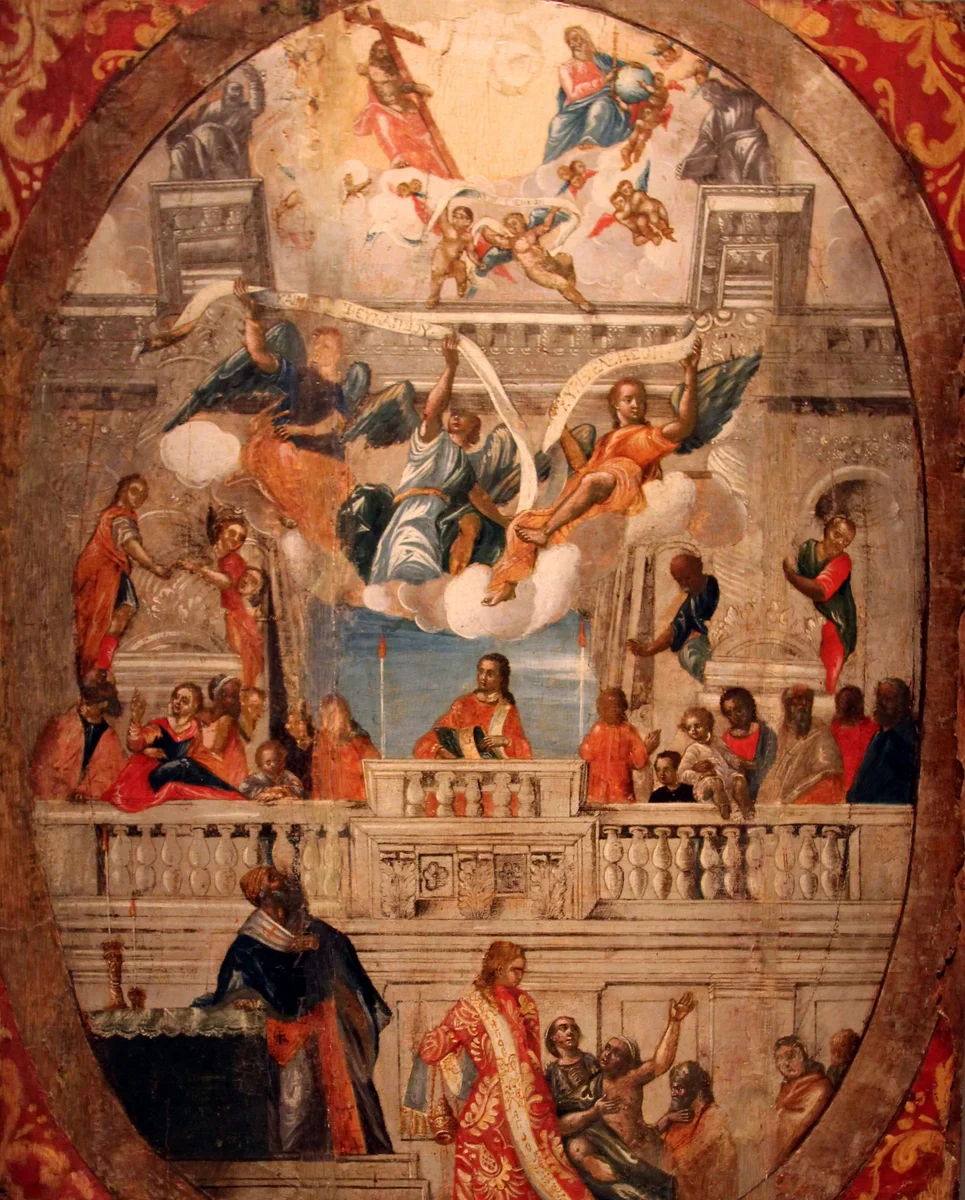
Furthermore, the artistic production of non-Muslim communities has all too often been dismissed as a derivative imitation of Western forms. Yet in Christian communities where figurative representation formed the core of religious praxis, icon painting, woodcarving, liturgical metalwork, and church architecture were foundational components of the broader Ottoman visual landscape. Panagiotis Doxaras (1662–1729), a pioneer of the Heptanese School whose The Liturgy of St Spyridon brilliantly integrated post-Byzantine iconography with Venetian oil painting realism, exemplifies the fluid cross-pollination across the Mediterranean and Ottoman spheres. Treating such traditions as peripheral curiosities divorces Turkish art history from its own organic anatomy.
This reality invites a compelling comparative hypothesis: a wall painting within a Pontic Greek church in Trebizond and the brushwork decoration (kalem işi) of an imperial mosque in Edirne may well share common pigments, workshop sensibilities, and stylistic vocabularies. While rarely charted in mainstream literature, this open research question can be rigorously tested through comparative archival, chemical, and stylistic examinations of workshops, guilds, and material supply routes.
Visual Plurality Across the Balkans and Anatolia
In nationalist historiographies across southeastern Europe, the centuries of Ottoman rule in Greek, Serbian, and Bulgarian lands are frequently depicted as a cultural eclipse or rupture. Yet at monastic epicenters such as Mount Athos and Ohrid, monumental fresco cycles and icon painting flourished continuously throughout the sixteenth and seventeenth centuries. Monasteries retained their endowments through imperial firmans, patronized by Orthodox merchant aristocracies and the hospodars of the Danubian Principalities. This production must be evaluated simultaneously within the administrative realities of the Ottoman state and the broader history of Eastern Orthodox art.
Anatolia mirrors this spatial plurality. While the majority of rock-cut churches in Cappadocia date to the Byzantine period, local Greek Orthodox communities continued to commission, construct, and decorate figurative churches well into the eighteenth and nineteenth centuries. Similarly, in Mardin and the Tur Abdin plateau, Syriac monastic architecture and stone masonry maintained their ancient aesthetic vibrancy under Ottoman sovereignty. These enduring traditions expose the theoretical limits of narrating Ottoman and Turkish art as a monolithic, monocultural entity.
Toward a "Shared Art History" and the Contemporary Canvas
A sterile inventory cataloging communal artifacts side by side is insufficient to resolve this historical amnesia. What is required is a paradigm shift: refusing to project contemporary national borders and rigid ethnic categories onto the visual heritage of the past. Instead of reducing an artwork to an isolated emblem of ethno-religious identity, it must be interrogated through the dynamic matrices of patronage, craftsmanship, guild mobility, geography, and material trade. In the same vein, writing the architectural history of an Ottoman city demands examining the mosque and the church not as antagonistic subjects of disparate academic disciplines, but as symbiotic components of a single urban fabric.
The visual heritage of this geography is a multifaceted whole where Eastern Christian iconography and Islamic ornamentation, figurative depiction and geometric abstraction existed side by side, passing tangent to one another within the same physical and intellectual space. For contemporary artists in Turkey, this shared memory is not a nostalgic ornament; it represents a profound repository of pluralism that liberates the face, the body, and the painted surface from ideological confinement. To dissect this heritage along sectarian boundaries does not merely falsify the historical record—it impoverishes the expressive memory of contemporary painting itself.