On November 20, 2024, at Sotheby’s New York contemporary art evening auction, Maurizio Cattelan's notorious 2019 installation Comedian sold for an astonishing $6.2 million, far exceeding its $1 million pre-sale estimate. The purchaser was cryptocurrency entrepreneur Justin Sun, who subsequently staged a press conference in Hong Kong on November 29 where he ceremoniously peeled and ate the banana before international media.
What Sun actually acquired was not the organic fruit itself. As the auction house catalog clarified, the lot comprises a Certificate of Authenticity signed by Cattelan accompanied by a fourteen-page installation manual specifying the exact 160-centimeter elevation and 37-degree angle at which the banana must be duct-taped to a white wall. The physical banana is utterly perishable and replaced every seven to ten days; the fruit auctioned by Sotheby's had been purchased that morning from a nearby Manhattan fruit cart for thirty-five cents.
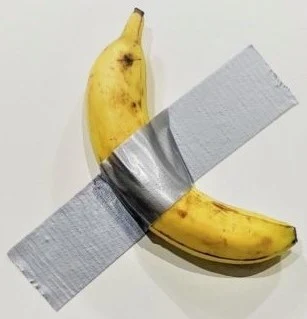
Originally debuted by Galerie Perrotin at Art Basel Miami Beach in 2019, Comedian became an instant global media sensation and satirical flashpoint. When performance artist David Datuna casually ate the display banana during the fair, the gallery simply affixed another fruit to the wall without interrupting the commercial reality of the artwork, whose three editions sold for $120,000 each (one subsequently entering the Guggenheim Museum's permanent collection).
The conceptual object and the uniqueness of figurative painting
Integrating Cattelan’s banana into a cycle dedicated to figurative depiction might appear paradoxical, yet it clarifies the central fault line of contemporary aesthetics. Since the 1960s, conceptualism has insisted that aesthetic value resides not in the unique material craft of an object, but in the dematerialized proposition and the bureaucratic certificate confirming ownership. Sol LeWitt’s wall drawings are sold as instructional certificates executable by hired draftspersons. Cattelan pushes this logic to its absolute satirical extreme: the material object is totally disposable, while economic aura is concentrated entirely within legal paper.
Figurative painting represents the direct antithesis of this condition. In the works of Frank Auerbach or Frans Hals, value is stubbornly embodied within the irreducible topography of physical pigment—the unrepeatable manual trace of an artist’s physical presence in time. An Auerbach head cannot be swapped for a fresh clone when the impasto gathers dust; conversely, substituting a rotten banana for a green one is the operational protocol of Cattelan’s piece.
November 2024 compressed these rival economies into a startling constellation: within the span of three weeks, a robot’s portrait of Alan Turing brought a million dollars, Frank Auerbach died after seventy years of monastic manual devotion to paint, and a duct-taped fruit commanded $6.2 million. This juxtaposition poses the central question of contemporary art: does value reside in the visceral manual trace of the human hand, in the synthetic output of an algorithm, or in the speculative theater of a financial certificate?