At the Threshold: Showcases, Jackets, and the Value of the Home
Just before stepping into the fair, I wandered through the luxury boutiques nestled among the restored historic stone buildings of Tersane Istanbul, browsing both the items and whatever price tags I could spot. When I then crossed into the fairgrounds and came face-to-face with the artworks in the booths and their corresponding prices, a strange sensation took hold. The retail price of a leather jacket or a designer coat on the racks of certain high-end brands was virtually on par with—and in some cases even higher than—the price of an average artwork hanging on the fair walls just a few hundred meters away.
That encounter offered an early vantage point for how to read the fair as a whole. In a redevelopment project where the Golden Horn shipyards—custodians of the city's industrial memory for over six centuries—have been gentrified into luxury hotels, high-end retail, and waterfront residences, the role assigned to art becomes easier to discern. Could this be where the much-debated mechanism of "art-washing" takes tangible form? A consumption hierarchy where remarkably chic, opulent, and decorative pieces produced for the salons of affluent residences trail behind a designer jacket...
In a cultural ecosystem where the wardrobe is deemed more precious and urgent than the home itself, let us venture a sweeping assertion: does art inevitably devolve into a complementary accessory to this luxury, sartorial poise, and sanitized lifestyle?
90s Effects and Grand Statements
Upon entering the fairgrounds, one of the immediate things that caught my attention was the scarcity of digital works, alongside their failure to deliver on what they seemed to promise. If you have been immersed in the digital realm, code, pixels, and new media since the 1990s, it is difficult to suppress a faint smile when confronting what is exhibited in the fair aisles under the banner of "contemporary digital art." Techniques, filters, and visual tropes well known thirty years ago from demoscene artists, early graphics software, and experimental video art are still presented to viewers today as though they were groundbreaking avant-garde breakthroughs.
For those outside the digital sector, or for curators lacking a technical memory of the medium, these displays might appear mesmerizing and radically "new"; yet for someone observing from within, the reality is quite different. The only genuine shift is that resolution has multiplied several K’s upward, backed by heavy computing power allowing seamless, long-form renders unfettered by file size or bandwidth constraints, displayed on pristine monitors. The technological hardware has expanded, the pixel density has thickened, but the underlying conceptual thought has barely moved an inch.
Textiles, textiles, textiles
Another unmistakable tendency across the fair was the conspicuous surge in woven and textile pieces. I personally have an affinity for fiber art and the deep bond weaving establishes with ancient craft and ancestral memory. Yet when an aesthetic vernacular finds fertile ground in the market, fair aisles swiftly surrender to an inevitable monotony. Fortunately, textile works have not entirely capitulated to this uniformity; I genuinely enjoyed examining almost all the woven pieces on display.
However, I must set aside the painted portraits on vintage carpets from this appreciation. Encountering the exact same aesthetic reflex year after year—rendered in routine variations of yellow, black, and blue across different booths—inevitably induces a sense of visual fatigue.
Plensa’s Juana and Johnny Depp
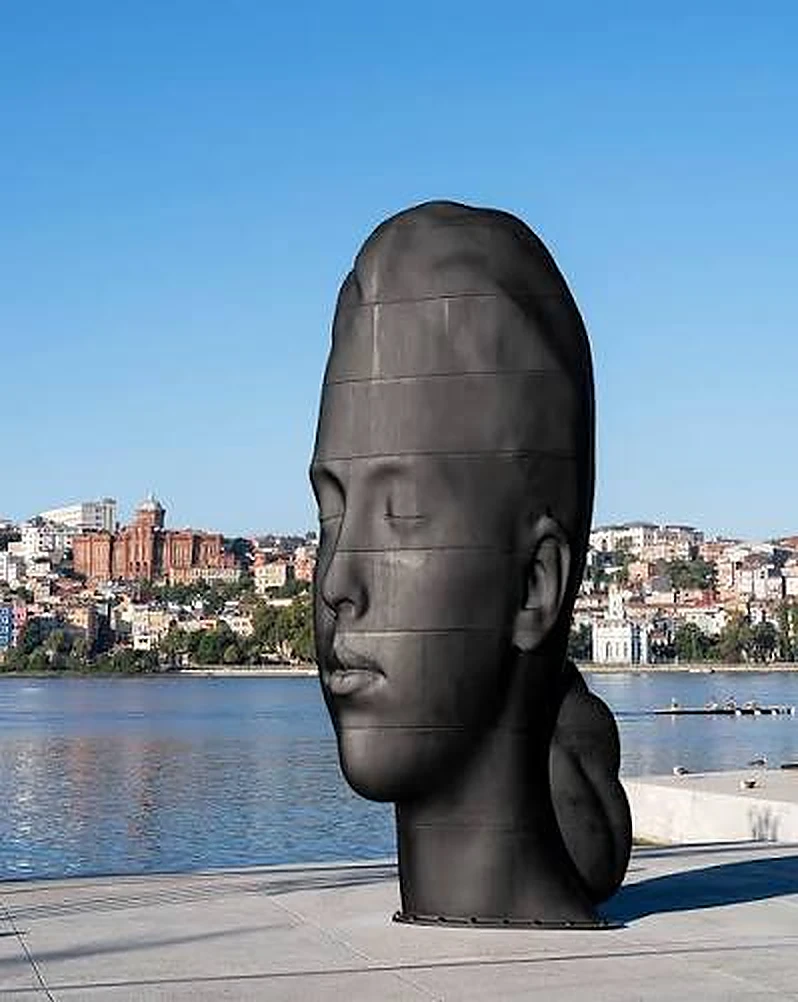
Tersane’s open waterfront quays and industrial expanses allowed the sculptural works to breathe far more comfortably. The monumental works by senior, internationally renowned sculptors lived up to their reputations; they commanded presence, drawing crowds and serving as backdrops for countless smartphone snapshots.
I must confess that Jaume Plensa’s Juana is a striking piece; I admired it. Yet I cannot write about it without a qualification. Curiously, something occurred that rarely happens to me: while I had thoroughly appreciated the sculpture in photographs and amateur social media posts, experiencing it up close did not elicit the same resonance. This had far less to do with the sculpture itself than with its immediate surroundings. Perhaps the dense foot traffic, the clutter of promotional decorations, directional signage, and surrounding booth glare compromised my perception. Somehow, the vantage point where visitors walk in relation to the sculpture’s placement at Tersane Istanbul seems to conceal its astonishing anamorphic perspective distortions or dilute its intended impact. Looking at the photographs once more, I found myself preferring its mediated image. It may well be that I have arrived at Baudrillard’s uncanny juncture where the sign supersedes the signified, where the image displaces the real. But that is precisely what I felt.
Among the fair’s most unexpected and buzzed-about exhibits was the debut sculpture by Johnny Depp. Setting aside the reflexive elitism the art world often directs toward celebrity crossovers, I encountered the work without initially knowing it was his. It was, in every sense, a bona fide first sculpture.
A Sanitized Sanctuary
Throughout this visit, the impression that etched itself most deeply into my mind was the fair’s thoroughly sanitized climate. It stood as one of the smoothest, most sheltered fair environments I have ever encountered. We undoubtedly inhabit a contemporary reality that complicates artists and galleries engaging directly with urgent political crises; I can empathize with that constraint to an extent. Yet the reality that not a single ripple of humanity’s most enduring, universal dilemmas—war, ecological devastation, rampant urbanization, or stark class disparities—managed to infiltrate these pristine white partitions remains genuinely unsettling.
Attributing this solely to political caution would be insufficient. What we are witnessing is an unspoken sociological mandate: the fair’s target demographic and collector base appears exhausted by the abrasive, contradictory, and painful facets of daily existence. The fair has been engineered as a tasteful, comfortable, and tranquil oasis where one can escape from worldly friction to "catch one's breath."
Perhaps this is precisely the tacit promise of a gentrified Tersane Istanbul: banishing surrounding hardship, congested transit, political friction, and inflation behind guarded ramparts. Contemporary Istanbul 21 functions as an expertly fabricated, decorative sanctuary that refuses to disquiet its visitors or pose unsettling questions on domestic walls.
Gallery Fatigue and the Fair's Backstage
Behind this luminous and tasteful vitrine, the cold, rigid mechanics of the market make themselves felt. While fair leadership narrates an annual triumph of internationalization, Contemporary Istanbul remains largely unvisited by the mega-galleries steering the global market (such as Gagosian or Hauser & Wirth), unable to transcend its standing as a "Tier-2" regional fair tethered to domestic capital and a modest circle of regional buyers. Furthermore, the fact that its founder, Ali Güreli, simultaneously oversees publications such as The Art Newspaper Turkey complicates the emergence of independent critical discourse in local media, drifting institutional assessment into promotional dispatches.
Fair management presents a narrative of recovery this year by pushing the number of participating galleries past 70, which is certainly a welcome development. Yet, despite all the lavish new resources, sprawling infrastructure, and heavy sponsorship network of Tersane Istanbul, it is worth noting that the fair has not yet matched its historical benchmark of 2015, when it hosted 102 galleries (68 of which were international). Exorbitant foreign-currency booth fees (by all accounts), compounded by soaring logistics, insurance, and operational costs, leave domestic galleries exposed to severe financial risk. Meanwhile, with weekend general admission surpassing 3,100 TL, art students and the city’s young cultural producers find themselves effectively locked out. Token student quotas squeezed into brief evening windows hardly dismantle this rigid socio-economic barricade. As the market contracts, does it withdraw ever deeper into its own sheltered, sterile bell jar?
Leaving the historic quays of Tersane behind, what lingers in memory is the crisp breeze over the Golden Horn, the price tags in luxury boutiques, and the sanitized colors gleaming gently on the walls. Art, perhaps more than it has in a very long time, demands a place in our lives as an "agreeable," placid, seamless, and entirely harmless decor.