German-born British painter Frank Auerbach passed away at his home in London on November 11, 2024, at the age of 93. Born in Berlin in 1931 into a Jewish family, Auerbach was sent to England in 1939 via the Kindertransport rescue initiative at age seven. He would never see his parents again; both were murdered in Auschwitz.
Studying in post-war London at St Martin’s School of Art and the Royal College of Art, Auerbach’s true artistic compass was forged in evening classes taught by David Bomberg at Borough Polytechnic. In 1954, he took over the North London studio in Mornington Crescent vacated by his lifelong friend and fellow painter Leon Kossoff. For seventy uninterrupted years, Auerbach inhabited that solitary room, working 364 days a year in relentless physical dialogue with oil and charcoal.
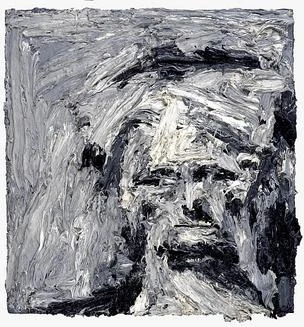
Painting by erasing
Auerbach's canvases are celebrated for their ferocious, architectural impasto. Pigment projects several inches off the support like a low-relief geological formation. Yet this monumental density was the residue of an intensely subtractive, paradoxical discipline: at the end of every grueling day, Auerbach would scrape away the entire session's wet paint with a palette knife, tossing mountains of discarded pigment into trash buckets, only to attack the naked surface again the following dawn. The final canvas was not built up through patient layers; it was the raw, frantic record of the final session that miraculously survived destruction.
Portraiture was the core crucible of this obsessive method. For decades, Auerbach painted only a tiny circle of intimate sitters—including his wife Julia, art historian Catherine Lampert, and Stella West (E.O.W.). These sitters sat for him weekly for up to forty years. Such prolonged scrutiny transcended mere anatomical likeness; it registered the deep, visceral familiarity between two living mortal beings across decades of shared duration.
Alongside Francis Bacon, Lucian Freud, and Leon Kossoff, Auerbach was canonized as a titan of the 'School of London'—painters who championed visceral figuration throughout decades when formalist abstraction and conceptualism dominated critical orthodoxies. In 1986, representing Britain at the Venice Biennale, Auerbach was awarded the Golden Lion.
In our current era of instant algorithmic image generation, Auerbach’s practice presents an extraordinary antithesis. Automated models generate synthetic human countenances in milliseconds without ever erasing a mark. Auerbach sought the truth of a face through decades of daily physical erasure. In his art, meaning resides not merely in the final image, but in the irreducible accretion of mortal time.