Participating in an interactive artwork has the capacity to alter the image that subsequent visitors will encounter. In such an environment, the participant does not merely experience an aesthetic event for themselves; they actively contribute to the conditions under which others will encounter the work. Collectivity here arises not from perceiving an identical static object, but through a continuum of sequential, cumulative encounters.
In my interactive project Person A, I synthesize participants' facial features with those of previous visitors, generating a perpetually evolving collective portrait. Deploying real-time facial recognition and generative machine models, I refuse to freeze the human subject into an immutable visual likeness, choosing instead to address identity as an ongoing, reciprocal relationship.
Reading Person A from this perspective demands that we interrogate not only whom the portrait depicts, but the mechanisms through which it mutates. The introduction of a new face destabilizes not merely the formal geometry of the composition, but the deeply entrenched notion that a portrait must belong exclusively to a singular individual.
When Does Interaction Enter the Artwork's Form?
To critically evaluate interactivity, we must look beyond the initial physical movement of the spectator and scrutinize its structural consequence within the work. Rendering an image momentarily visible, transforming its internal syntax, and leaving an enduring imprint that persists into subsequent encounters represent fundamentally distinct orders of engagement.
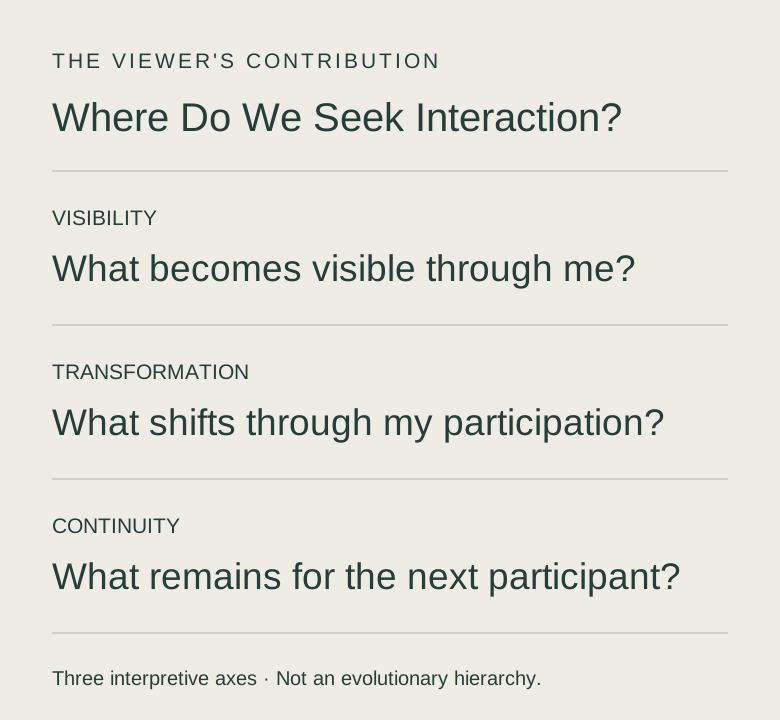
These three inquiries do not establish an evolutionary hierarchy. A tightly constrained range of action can generate a deeply arresting aesthetic encounter; conversely, an interface offering dozens of interactive toggles can dilute the spectator's perceived agency into triviality. What remains artistically decisive is the conceptual integrity binding human participation to the resulting aesthetic experience.
The familiar adage that “the viewer completes the work” acquires analytical weight through these distinctions. Does completion mean merely triggering an automated script, modifying visual parameters, or actively co-authoring meaning? In Person A, the incoming facial scan is synthesized with prior participants into a continuously mutating visual presence. The viewer's role expands from seeking their own reflection to participating in the emergence of a collective image.
The Mutating Collective Portrait in Person A
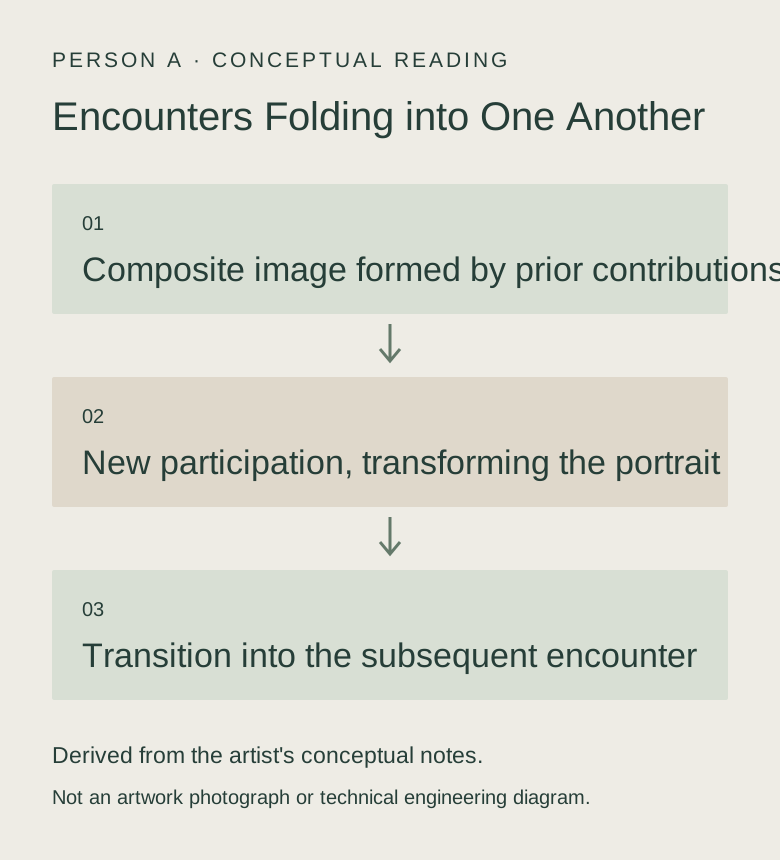
In Person A, every new countenance transforms the image forged by previous visitors; the process continues indefinitely with each subsequent spectator. Portraiture is thus conceived as a fluid mode of representation where discrete encounters concatenate over time. That the image mutates does not imply its historic continuity is severed: each new participant enters into dialogue with the composite form that preceded them.
In this architecture, the concept of the “collective” indicates an entirely different relationship than a gallery of isolated portraits placed side-by-side. A person's facial presence achieves visibility precisely within the ongoing continuum of other faces. One cannot simply conclude that individuality is entirely dissolved, nor that it remains pristinely intact. It is precisely this unresolved productive tension that the work opens for debate.
This dynamic introduces a profound question regarding the temporality of portraiture. Before a static canvas, the gaze circulates across a resolved, completed surface. In Person A, representation remains perpetually open to disruption by the next arriving visitor. The collective portrait is defined not solely by the face visible at this instant, but by its ontological incompleteness.
Appearing Together While Remaining Singular
The ideal of collective portraiture possesses undeniable allure, yet it brings forth a difficult inquiry: In the process of appearing together, what becomes of that which is singular to the person? Obscuring this tension beneath a simplistic celebratory narrative of harmony diminishes the critical friction generated by the work.
Collectivity can be structured as a dialogue in which differences remain recognizable and articulate. In other configurations, individual traits may be subsumed and blurred into an undifferentiated composite. Which experiential reality an artwork actually produces cannot be deduced from its conceptual title alone. How the participant discerns their own trace, how they perceive the presence of others, and how this metamorphosis is visually delivered are paramount.
Here, the strength of contemporary art lies in its refusal to offer immediate, reassuring resolutions. The spectator is invited to reflect simultaneously upon entering a communal whole and witnessing the porous boundaries of their own identity. The work problematizes how collectivity reshapes singularity directly through sensory experience.
Throughout my practice, I explore identity, memory, and the limits of representation. The collective portrait of Person A represents the computational embodiment of these inquiries. It engages directly with the questions of singularity and bodily presence that animate my figurative paintings, without requiring that the two mediums arrive at identical conclusions.
Another Encounter: Under Scan
In Rafael Lozano-Hemmer's renowned relational installation Under Scan, portraiture and public participation intersect within a distinct spatial dynamic. The artist's documentation describes video portraits projected onto public plazas that activate exclusively within the cast shadows of passersby. As pedestrians move across the square, the conditions of visibility governing the portraits shift accordingly. Official artwork documentation
In Under Scan, the pedestrian's physical silhouette serves as the projection screen that reveals a pre-recorded portrait; in Person A, conversely, the participant's own facial biometric data actively transforms the evolving composite. Both works forge intimate relationships between spectator and portrait, yet one foregrounds the spatial conditions of encounter, while the other emphasizes the algorithmic mutability of the collective image.
We can formalize this comparative analysis through three core questions: What specific condition renders the portrait visible? Does participation alter the portrait itself, or merely the terms under which it is perceived? Does the contribution of the previous visitor persist into the next person's experience? Even when the analytical questions are uniform, the answers must be derived rigorously from each artwork's documented operations.
This formal comparison demonstrates that interactivity cannot be circumscribed by a single technique. A portrait may be uncovered through the spatial trajectory of a body, or re-authored through facial data. In both instances, the meaning of the human image is co-determined by the live encounter that brings it into being.
How Are the Rules of Participation Rendered Visible to the Viewer?
In interactive art, it is by no means mandatory that every computational rule be immediately legible. Ambiguity, exploratory curiosity, and surprise can constitute essential aesthetic dimensions of the encounter. Nonetheless, how the spectator comprehends what they are participating in remains a vital artistic question.
Generally, in interactive works, an immediate visual response following a physical gesture assists the participant in recognizing their own agency. When the feedback loop is delayed, or when individual input is compounded with algorithmic noise, discerning one's causal impact becomes significantly more demanding. Latency and feedback loops profoundly calibrate how the spectator conceptualizes their position within the work.
A corresponding attentiveness is required when evaluating documentation. A solitary still photograph captures merely a frozen millisecond of an evolving system. Video documentation assists in conveying temporal motion, yet it rarely replicates the somatic experience of standing within the sensor field and recognizing one's own presence. In analyzing documentation, we must remain conscious of which experiential strata are preserved and which are irretrievably flattened.
For this reason, when discussing Person A, conceptual artist statements, video documentation, and the phenomenological encounter must never be conflated as interchangeable. Each yields distinct categories of knowledge. Examined together, they enable the critical questions posed by the artwork to be debated with nuance.
What Remains When Leaving the Artwork?
Standing before an interactive artwork, three questions naturally emerge: What changed through my participation? To what degree was I able to perceive this transformation? And in what form will the person who follows me encounter my lingering trace?
The artist's text articulates the conceptual parameters of participation; the encounter itself allows the individual to experience their place within those boundaries. Oscillating between seeking their own reflection and perceiving the shifting collective whole, the spectator finds that community ceases to be an abstract slogan and becomes an experiential inquiry.
In this regard, the collective portraiture of Person A introduces a radically different temporal dimension to the problem of recording human presence. The record is no longer an archival freeze of a past moment; it becomes an active participant in an ongoing chain of encounters. The spectator is invited to ask not merely how they appear, but what it genuinely means to appear in relation to others.
You can explore the resonance of these inquiries across my broader practice in my digital works catalogue and my artist statement. Each artistic medium contributes its own specific mode of encounter to this enduring investigation.