The same image of a human face can participate in a question of identity verification at a border checkpoint, an impulse toward recollection within a family photo album, or a critical debate on representation within an art gallery. The question addressed to the image is as consequential as the visual information it holds. Matching a visual record to the correct individual and understanding that person's existential life belong to entirely different orders of engagement.
It is possible to conceptualize the dialogue between biometrics and visual art from this fundamental distinction. We may ask for which specific operations mathematical measurement proves sufficient, where a mode of representation exceeds its own instrumental limits, and under what conditions the human subject is genuinely rendered visible. The research binding my painting practice, spatial installations, and digital works evolves around these foundational inquiries.
The domain opened by contemporary art here does not promise to decipher the entirety of an individual's truth from an optical image. Rather, its imperative is to expose how the gaze itself is mediated and organized. Sometimes this mediation manifests directly upon the face itself, and sometimes within the narrow aperture that grants us access to seeing it.
How Does a Face Become a Question for the System?
Facial technologies should not be conceived as a singular, monolithic operation. The National Institute of Standards and Technology (NIST) classifies facial evaluations across distinct operational tasks such as identity verification and image analysis, maintaining strict categorical divisions between one-to-one (1:1) verification and one-to-many (1:N) identification protocols. This technical taxonomy demonstrates that the specific expectations imposed upon the algorithm must be rigorously defined. NIST, Face Technology Evaluations
One-to-one comparison may be understood as asking whether a presented facial capture matches a specific pre-existing reference record. In one-to-many identification, conversely, the probe image is evaluated across an expansive database of candidates. This explanation does not attempt to chart every mathematical nuance of algorithmic code; rather, it demonstrates that these two operational tasks formulate fundamentally divergent questions.
In colloquial language, our casual use of the verb “to recognize” can produce profound semantic confusion. When we speak of recognizing a lifelong friend versus a computational system recognizing a face, the same lexical term is deployed. Yet the former involves shared temporal duration, vulnerability, mutual trust, accumulated misunderstandings, and evolving emotional bonds. The latter constitutes merely a bounded mathematical comparison against spatial landmarks. The shared vocabulary in no way equates the ontological scope of the two acts.
Preserving this epistemological distinction enables a more critical and disciplined relationship with emerging technology. Rather than opposing an automated instrument for failing to accomplish tasks it was never designed to undertake, we can interrogate the specific domain in which its output claims validity. A mathematical match may suffice to complete an administrative transaction; however, circulating that computational result as comprehensive knowledge of a human being demands an entirely different philosophical critique.
Where Does the Limit of the Record Begin?
Every documentary record is structured according to the functional requirements of the process it serves. Which features are isolated, extracted, and stored—and which conclusions are drawn—correlate directly to this institutional purpose. A museum tombstone label provides artist name, medium, date, and dimensions; it cannot encapsulate the duration spent standing before the canvas nor the psychological resonance evoked within the spectator. The utility of the catalogue entry does not depend upon exhaustive omnipotence.
The critical fallacy emerges when the vital distinction between the record and the living subject of that record is elided. When isolated features are treated as the exhaustive totality of the person, a bounded fragment of data is invested with an explanatory authority far exceeding its legitimate capacity. Assuming that we know an individual's moral character, ethical intent, or existential biography from a facial image replicates this exact speculative leap.
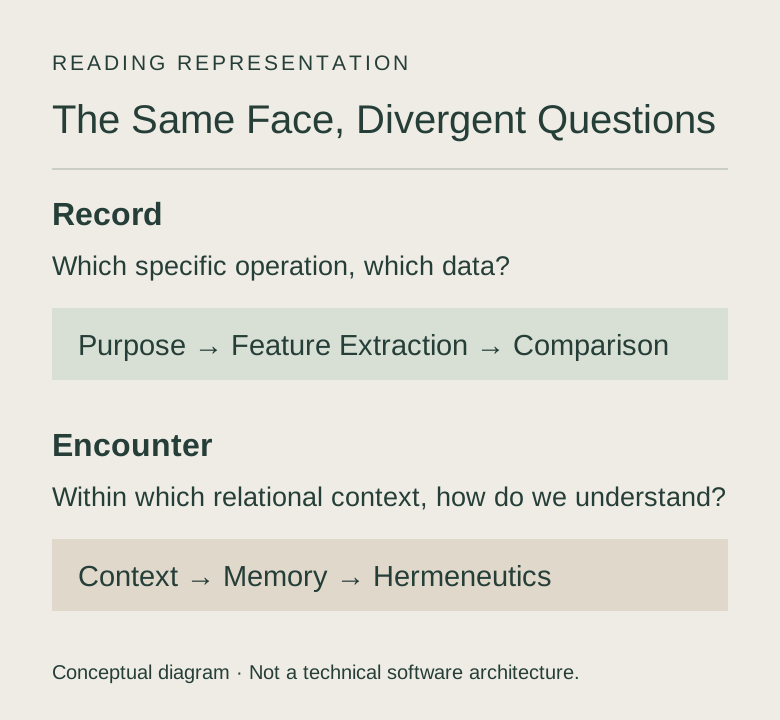
The two parallel trajectories articulated in the diagram render these divergent modes visible. In reading a record, institutional purpose, extracted features, and comparative benchmarks govern the interaction; in an authentic human encounter, temporality, socio-historical context, and hermeneutic interpretation take precedence. This division does not claim that the two spheres are entirely hermetic. Rather, it proposes keeping transparent which category of knowledge responds to which question.
Appending the exact date of capture to an identification photograph alters how the image is interpreted. Introducing a personal narrative from that historical juncture generates a different relationship altogether. The newly introduced context does not render the primary image invalid; rather, it illuminates precisely what the image, left to itself, could never articulate.
Lived Experience Against the Standardized Face
Conceiving of the human face through lived experience (yaşanmışlık) is not an exercise in deciphering a clandestine biography from superficial physiognomy. We cannot deduce with certainty from an image alone which historical event carved a specific wrinkle, or which private grief burdens a glance. Such an assertion would merely supplant one reductive dogma with another speculative certainty under the guise of critiquing representation.
Lived experience invites a more attentive and disciplined question: How might we gaze upon a face while acknowledging that it always bears more than it reveals? Can we hold open the space that the image leaves unexplained, rather than instantly consigning the subject to an administrative category?
One of the vital capacities offered by an artwork is its ability to alter the temporal duration of looking. We return to an overlooked detail, correct our initial impression, and discern a hitherto unseen relationship across the same surface. While the artwork may not provide novel factual data concerning the sitter, it exposes the precipitous haste of our epistemological claims. The aesthetic power of art resides not in disclosing an absolute truth, but in reopening judgments we presumed settled.
This interpretive stance is by no means exclusive to oil painting. Photography, video, critical writing, and interactive installations can equally interrogate the viewer's premature categorization. What is essential is not categorizing by medium, but investigating how the work orchestrates and challenges our gaze.
What Question Does Art Add to the Record?
In my installation Acute Angle, I utilize two large-scale paintings situated within controlled architectural lighting. This spatial configuration allows the conditions of visibility to be examined through a concrete material encounter. In the documentation, a narrow vertical gap appears between towering monochrome panels, framing only a fraction of the painting while cast illumination spills across the gallery floor. View project entry
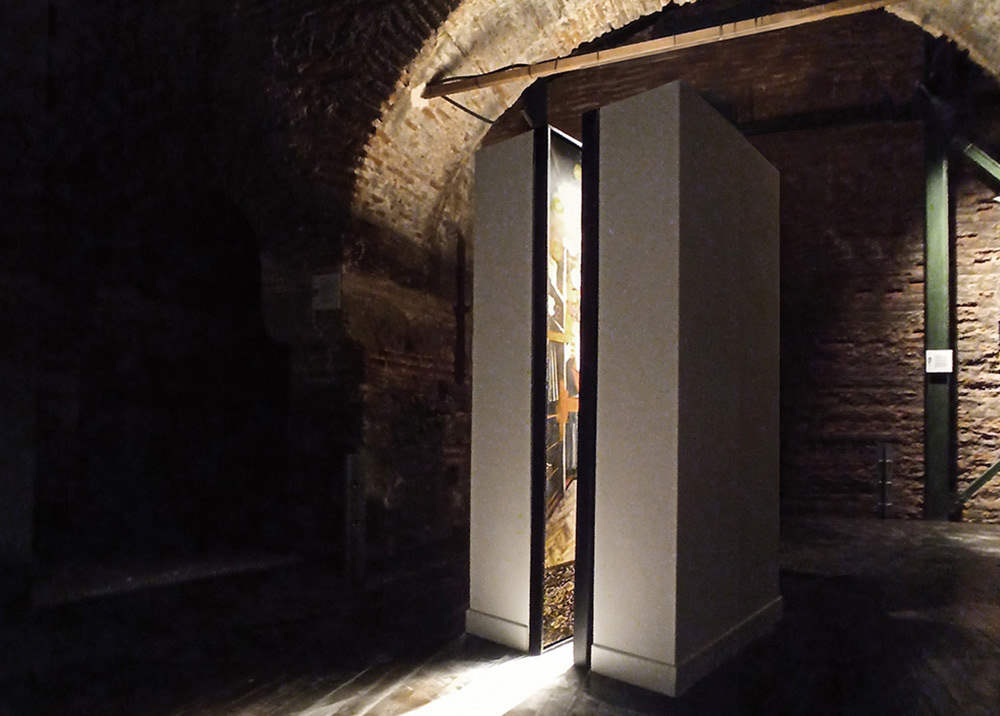
In this architectural arrangement, the painting is physically present; yet the spectator's access to it is structurally constrained. The bodily coordinates of the viewer and the strict width of the aperture dictate how much of the work can be perceived simultaneously. The reading derived from this encounter demonstrates that incomplete seeing is not merely an optical defect of the eye or the image. The very spatial conditions of viewing actively construct this incompleteness.
What enables us to conceptualize this installation alongside biometric registration is that both systems depend upon deliberate structural choices that delineate the field of view. This juxtaposition materializes an inquiry frequently bypassed in abstract semiotic discourse: When something remains inaccessible to sight, are we speaking of the nonexistence of the invisible, or the systematic curation of our gaze?
The aperture between the architectural panels transforms the boundary of seeing into an integral constituent of the aesthetic experience. While observing the painting, we simultaneously confront the spatial apparatus that both enables and restricts our perception. Facing an archival or biometric record, we can similarly interrogate the presented data alongside the socio-technical conditions through which it was extracted.
BIOMETRIC: The Question Uniting My Practice
I construct my artistic practice around inquiries into how the human subject is visually represented, and what residual essence remains when a human being is captured into an institutional record. My figurative paintings executed with earth and botanical pigments, alongside digital installations employing facial recognition and generative machine models, constitute complementary research instruments. My background across visual design, computational code, and media theory continually informs this investigation.
In my forthcoming solo exhibition BIOMETRIC, I bring these divergent practices together under a unified critical framework. In figurative painting, questions of lived experience, bodily vulnerability, and existential singularity come forward; in digital work, identity is explored as an evolving, contingent relationship. This does not mean the works serve as literal visual translations of one another. Rather, a shared conceptual question confronts different material systems, yielding distinct artistic outcomes.
To navigate this framework, we must discuss the ethical boundaries of representation before declaring allegiance to technological tools. Registering a face can be a functionally necessary operation. My artistic inquiry begins where that technical output is conflated with the totality of the person: What essential dimensions of human existence are erased in that leap? I address this inquiry further in my artist statement.
Looking Again at a Record
Freezing a face within an institutional record does not exhaust the spectrum of relationships that may be forged with it. An evidentiary result sufficient for an identity audit may serve merely as a point of departure for art, historiography, and collective memory. Consequently, when encountering any visual record, it is crucial to maintain three epistemological distinctions: what we directly see, what we know through external sources, and what we interpret.
Acute Angle provides a tangible paradigm for this attentiveness. Rather than dismissing the concealed portions of the canvas as nonexistent, we analyze the architecture that restricts visibility. Similarly, in facial representation, rather than presuming selected algorithmic parameters constitute the complete human being, we can interrogate the specific operational question according to which the record was engineered.
BIOMETRIC returns this question directly to the human countenance: Once the measurement is finalized, how do we continue to genuinely look at the person before us?