In Rembrandt's 1660 Self-Portrait, the illuminated face registers first, followed by the deep cap and the heavy brown garments. The tonal darkness surrounding the visage concentrates visual scrutiny squarely upon the flesh. When we linger before the canvas, we begin to perceive not merely the appearance of an aging man, but how that presence was constructed through pigment, medium, and light.
It is precisely at this juncture that memory in portraiture becomes worthy of philosophical contemplation. In what manner does a painting remember a face? How does the temporality registered across the painted surface correlate with what we historically know of the sitter's life? When we separate these strata, portraiture yields far more than a physiognomic reading that purports to extract character from facial contours.
To examine this problem from complementary perspectives, I examine Rembrandt's self-portrait alongside an image from my series My Incidental Reincarnations. In one, the countenance is built through the materiality of oil paint; in the other, a familiar face is transposed into the codified visual grammar of historical portraiture.
Which Question of the Portrait Does Resemblance Answer?
When evaluating a portrait, asking “does it resemble the subject?” is an understandable point of departure. Preserving recognizable physical features can be one legitimate motivation of portraiture. However, explaining the totality of compositional decisions through this metric alone proves inadequate. Two images exhibiting identical facial likeness can establish radically disparate encounters with the viewer.
The inclination of the head, the physical scale of the torso, the vector of the gaze, or the symbolic attributes framing the figure actively govern how the painting is received. Without altering who the face belongs to, these compositional choices renegotiate the emotional and psychological distance between the sitter and ourselves. Portraiture must therefore be read not solely through physiognomy, but through the spatial and social matrix within which the face is embedded.
Jean Sorabella's scholarly essay for The Metropolitan Museum of Art examines the manifold functions of portraiture in Renaissance and Baroque Europe, highlighting commemoration, dynastic consolidation, and public representation. These historical precedents demonstrate that documenting physical appearance was never the exclusive duty of the portrait. The Met, Portraiture in Renaissance and Baroque Europe
Turning to contemporary practice, a similar attentiveness can be developed. Alongside asking how realistic a painting is, we can interrogate where it situates the spectator. Does the figure confront us directly? Is the sitter absorbed in private thought? Do we meet at eye level, or gaze upward? These deliberate inquiries facilitate the transition from recognizing a likeness to genuinely engaging with an artwork.
Multiple Temporalities on a Single Surface
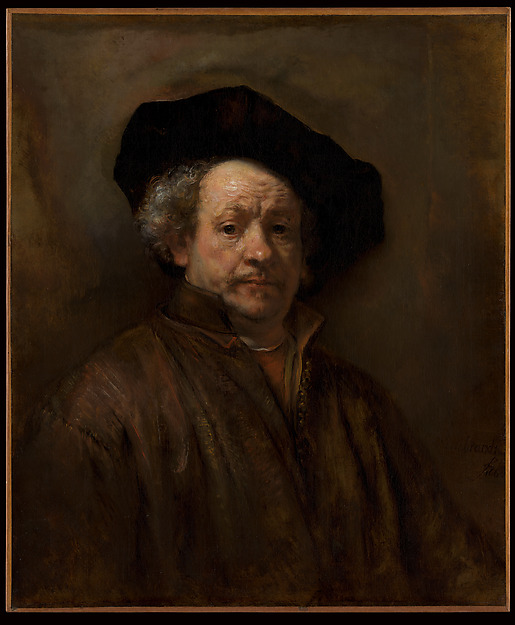
The Met's curatorial catalogue notes that Rembrandt executed the face in his 1660 self-portrait using heavy impasto applications, scoring delicate hair strands into wet paint using the wooden butt of his paintbrush. Here, paint is not merely a transparent vehicle for depiction; the illusion of the face and the tactile materiality of oil paint coexist simultaneously. The Met, Artwork Entry
We can observe this tactile reality directly upon the canvas. The illuminated passages of the flesh and the broad dark mass of the tunic do not demand identical degrees of ocular attention. While the gaze is drawn into the illuminated forehead and cheekbones, the heavy silhouette of the cap delineates the perimeter of the head. These are formal compositional observations, not speculative psychoanalytic diagnoses of what the artist felt at that hour.
At least two temporal registers unfold across the surface: the depicted age of the sitter, and the physical traces of labor that formed the stratigraphy of paint. The viewing duration of the spectator introduces a third temporality. What we register at first glance as a face opens upon second glance into an assembly of modulated brushstrokes, dragging glazes, and scratched passages.
Memory here is inseparable from the surface: in remembering a portrait, we recall not merely facial features, but the precise material conditions through which that presence crystallized.
Gaze, Stance, and Void
One effective method of reading a portrait is to begin at the focal center of the face and move outward toward the periphery. Observe first the vector of the eyes, then the relationship of the head to the shoulders, and finally the atmospheric space surrounding the figure. This disciplined sequence allows composition to be described without resorting to psychological assumptions.
A gaze locked directly onto the viewer can evoke an acute sense of encounter. A head turned sideways, conversely, directs attention toward an unseen horizon beyond the frame. Yet these compositional effects should never be codified into dogmatic axioms. A direct gaze does not invariably signify confidence, nor does an averted glance guarantee shame. Meaning materializes only within the contextual dialogue of the whole work.
Negative space is an active participant in this dialogue. The perimeter of void around a sitter determines how intimately we experience the figure. A torso cropped tightly by the canvas edge establishes an entirely different proximity than a full-length figure standing in an expansive interior. A resting hand or the tilt of a collarbone can reveal a rhythmic counterpoint that the face alone cannot sustain.
Synthesizing these formal observations clarifies how the painting choreographs our looking. Shifting from eye to shoulder, and from shoulder into surrounding shadow, continuously recalibrates our intimacy and distance with the subject.
Whose Memory Is It?
When analyzing portraiture, it is productive to distinguish three distinct subject positions: the artist, the sitter, and the spectator. Their respective experiential horizons may intersect, but they remain irreducibly distinct. An unrecorded private dynamic may have existed between painter and model; the model may have experienced their own likeness through a divergent self-perception; and the spectator inevitably approaches the canvas carrying personal associations.
Acknowledging this divergence underscores the responsibility of articulating the basis of our interpretations. Stating, “This portrait reminds me of someone from my childhood,” expresses the spectator's subjective reality. Asserting, “The artist painted this figure to evoke their own childhood memory,” demands independent historical documentation. One cannot leap uncritically from the former to the latter.
The same intellectual rigor applies when engaging with an artist's personal statement. An artist's commentary offers a compelling entryway into the work, yet it is under no obligation to exhaust the painting's communicative potential in a single thesis. A viewer who studies the statement may subsequently discern relationships across the canvas that extend beyond the artist's stated intent.
What animates memory in portraiture is not the universal uniformity of recollection, but the capacity of a singular image to encounter diverse human lives. What renders this encounter meaningful is not arbitrary projection, but transparently acknowledging the grounds from which our interpretation arises.
The Face and Changing Context in My Own Work
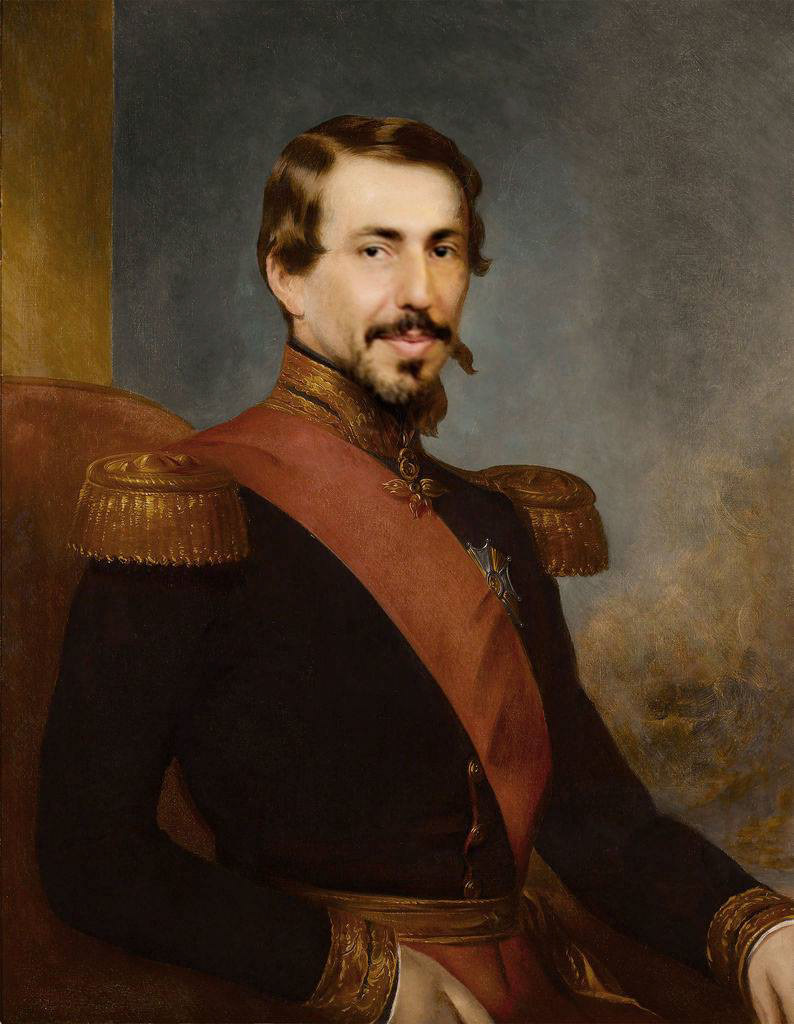
In my series My Incidental Reincarnations, I digitally insert my own facial features into historical paintings across divergent epochs and geographies. In this specific work, my countenance is situated inside a rigid historical portrait convention. The red sash, gold epaulets, dark uniform, and sovereign stance envelop the face within an overt language of power and social class. Other works from this series can be examined on my project page.
The physiological recognizability of the face is not the sole determinant here. The ceremonial uniform and authoritative posture forcefully dictate how the image is deciphered. Imagining the identical face dressed in casual contemporary clothing immediately exposes how much of the social authority attributed to a portrait is derived from external signs of status.
This composite image operates through a methodology distinct from Rembrandt's oil painting. In Rembrandt, meaning emerges from the physical impasto of oil on canvas; here, it emerges from the conceptual displacement of an identity across historical boundaries. The comparison demonstrates that portraiture functions simultaneously through material surface and socio-historical sign systems.
In my figurative paintings produced with earth and plant pigments, questions of vulnerability, mortality, and singularity take center stage; in this digital series, identity is interrogated through historical contingency. Uniting both bodies of work is a persistent inquiry: To what extent does the optical depiction of a face ever suffice to represent a human being?
Five Questions for Looking at a Portrait Anew
The first question addresses scale: At what intimacy or distance is the face presented? The second considers gaze: Where is the figure's attention focused, and where does it guide mine? The third investigates surface: Which passages are loaded with impasto, and which remain delicate, transparent, or unresolved?
The fourth question widens the spatial horizon: What dynamic exists between the figure, surrounding objects, and surrounding void? The fifth reflects upon our interpretive stance: Which elements of our reading stem from direct visual evidence, which from documentary sources, and which from our own projected memories?
These inquiries are not a formulaic test to solve an artwork. They do not necessitate a single correct answer. Rather, they slow the tempo of looking, substituting patient observation for hasty judgment. Memory in portraiture does not require unearthing a secret plot hidden behind the canvas. Often, it emerges within the quiet space between our first glance and our second.
Returning to a portrait can become far more than recognizing a face. In discovering an overlooked brushstroke or subtle shadow, we simultaneously confront the visual habits through which we construct meaning in the world.