The year 2024 commenced amidst an unprecedented traveling retrospective dedicated to the Dutch Golden Age master Frans Hals. Following its debut at London's National Gallery, the exhibition moved to Amsterdam's Rijksmuseum from February to June 2024, concluding at the Gemäldegalerie in Berlin in November. Comprising roughly fifty seminal canvases, the project marked the most comprehensive institutional survey of Hals in more than three decades.
The undisputed cynosure of the tour was Hals's 1624 masterpiece, The Laughing Cavalier. Anchored in London's Wallace Collection since the 1870s, the canvas had never previously crossed the English Channel due to the founder's strict bequeathal prohibitions against external loans, which the trustees relaxed only in 2019. Its presentation at the Rijksmuseum represented the painting's inaugural return to Dutch soil after an exile exceeding a century and a half.
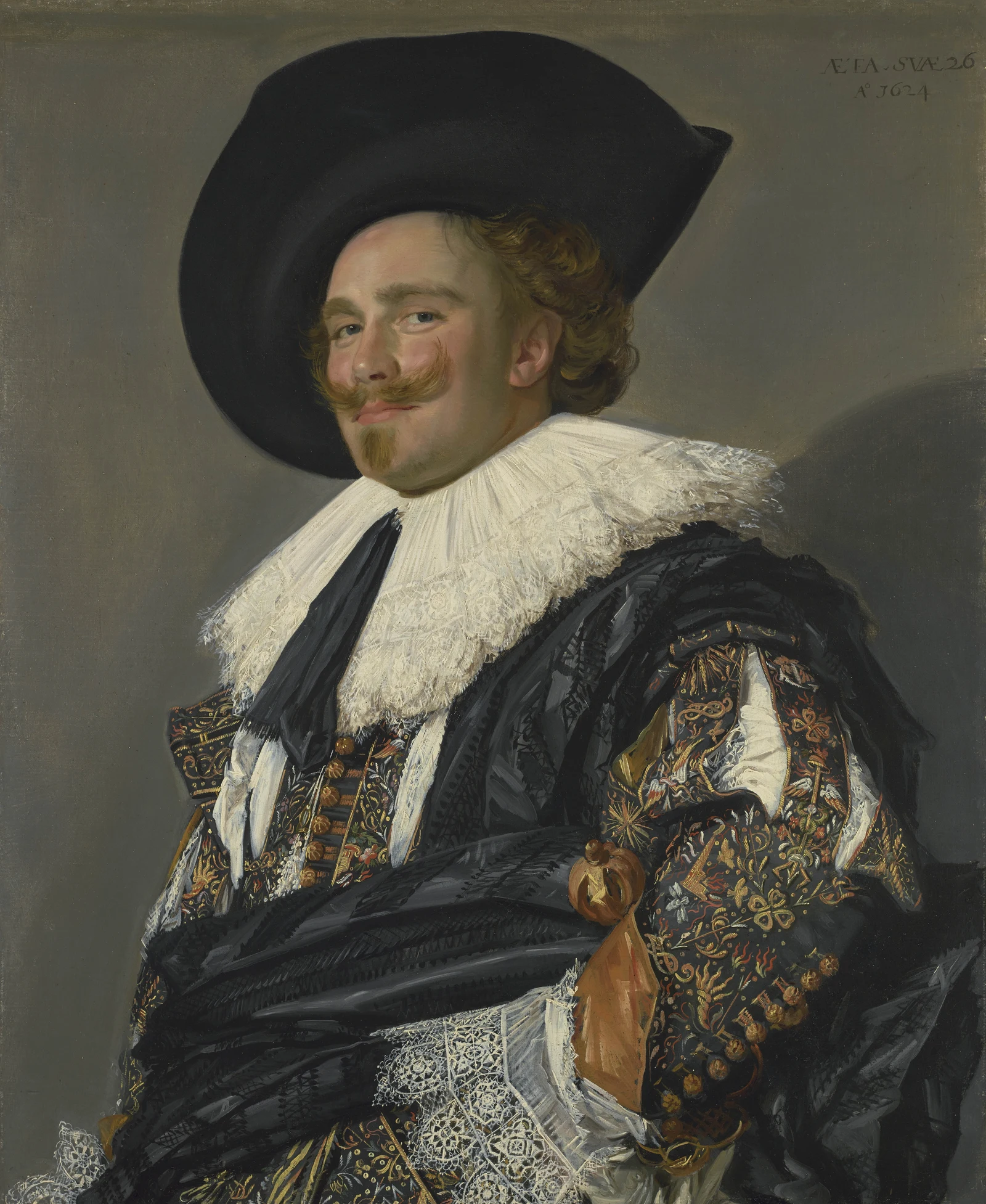
The title itself is notoriously deceptive. The enigmatic, gorgeously attired subject does not break into open laughter; his upturned mustache merely frames a fleeting, supremely confident smirk. Moreover, the moniker 'The Laughing Cavalier' was never conferred by Hals himself, having been coined by Victorian critics in the late nineteenth century as the image entered mass reproductive circulation.
The difficulty of painting a smile
Hals's transformative contribution to Western portraiture stems from achieving what classical academic convention rigorously avoided: depicting a human smile. Facial expressions dissolve in seconds; over painting sessions lasting days or weeks, sustaining an authentic smile is physiologically impossible. Academic portraiture thus defaulted to solemn, immobile composure. Hals broke this stasis through audacious, loose, visible wet-in-wet brushstrokes. Seen close-up, his bravura passages dissolve into seemingly chaotic marks; viewed from distance, they cohere into the sparkling illusion of vital breath and spontaneous amusement.
This painterly liberty was rediscovered two centuries later by Édouard Manet and the French Impressionists, sparking a modern tendency to retrospectively canonize Hals as a proto-modernist rebel. Yet this is an anachronistic reading: in his own time, Hals operated as a pragmatic, highly sought-after portraitist responding to the competitive civic vanity of Haarlem's burgeoning mercantile elite.
In the contemporary era of the smartphone snapshot, a smile has become the default, automated reflex of portraiture. Cameras freeze micro-expressions in milliseconds. Hals's canvases remind us of an existential question anterior to optical automation: how far can the manual touch of a painter capture that which is fundamentally fleeting? In our current age where generative artificial intelligence synthesizes synthetic human warmth with frictionless ease, Hals's manual struggle to arrest a live glance acquires urgent, renewed gravity.