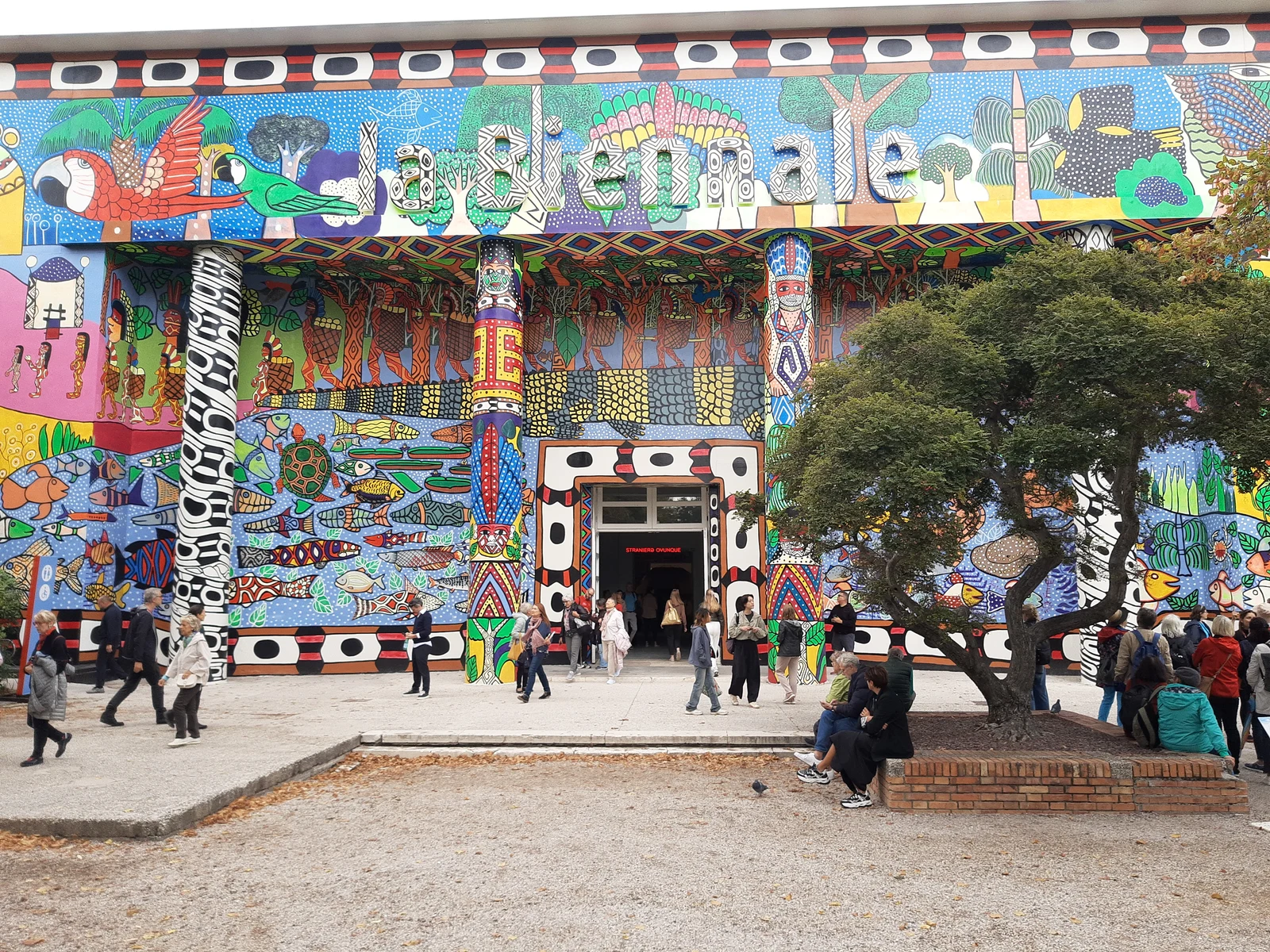
The 60th International Art Exhibition of the Venice Biennale unfolded from April to November 2024 under the banner Stranieri Ovunque – Foreigners Everywhere. Curated by Adriano Pedrosa, artistic director of the Museu de Arte de São Paulo (MASP) and the first Latin American curator to helm the Biennale, the title derived from an ongoing series of multilingual neon sculptures begun in 2004 by the Paris-born, Palermo-based conceptual collective Claire Fontaine.
Pedrosa bisected the exhibition into a contemporary sector emphasizing indigenous, queer, and displaced practitioners, alongside an ambitious historical sector: the Nucleo Storico. Dedicated to 20th-century modernisms across Latin America, Africa, the Arab world, and Asia, its crowning centerpiece was the colossal 'Portraits' gallery, assembling paintings by 112 artists working between 1905 and 1990.
Off-center portraits of modernism
This gallery constituted the Biennale’s most radical proposition for figurative painting. Hegemonic narratives of Western modernism have long traced a linear trajectory anchored in Paris and New York, portraying the transition from representation toward pure abstraction as an inevitable historical destiny. In that eurocentric schema, non-Western painters were marginalized as belated disciples. Pedrosa’s salon inverted this map: throughout the twentieth century in Brazil, Nigeria, India, Egypt, and Mexico, painters deployed modernist syntaxes specifically to interrogate local bodies and indigenous identities without viewing abstraction as an aesthetic obligation.
Yet this curatorial strategy prompted legitimate critical debate. Crowding over a hundred artists in dense salon-style arrays risks flattening radically disparate political and geographic contexts into a homogenized 'Global South' pastiche. This reflects the familiar paradox of institutional revisionism: the urgent impulse to grant visibility to neglected histories often neutralizes the singularity of individual artistic voices.
The major accolades favored other mediums: the Golden Lion for best participation in the international exhibition went to the Mataaho Collective—four Māori women artists from Aotearoa New Zealand for Takapau, a monumental canopy woven from reflective tie-down straps—while the National Pavilion Golden Lion was awarded to Archie Moore's haunting genealogical installation kith and kin in the Australian pavilion.
For Turkish modernism, Pedrosa’s intervention resonates compellingly. The figurative syntheses of early Republican painters—from the 1914 Generation through the D Group and Bedri Rahmi Eyüboğlu—demand precisely this non-teleological recalibration. Reading Turkish figuration merely as an echo of Paris ignores how local painters mobilized the human likeness to confront complex cultural transitions.