An image may be computationally generated, transferred onto physical archival substrate, exhibited as a tangible spatial object, and subsequently re-photographed to circulate across digital displays. Across these transitions, the work does not remain immutable: scale, tactile surface, accessibility of fine detail, and the bodily coordinates of the spectator undergo continuous transformation. Designating an artwork solely according to its momentary medium overlooks crucial aesthetic relationships.
Post-digital art opens a critical dialogue on the interdependence between traditional and computational tools in an era where digital technologies have thoroughly permeated contemporary culture. The prefix “post” does not signal the demise of the digital. Rather, in an environment where algorithmic production is no longer novelty, it interrogates what material choices and visual encounters genuinely mean.
I anchor this debate in two projects from my own oeuvre: Faith Is a Fine Invention and My Incidental Reincarnations. The former orchestrates typography, architectural fragments, and human silhouettes within a stratified digital composition; the latter transposes contemporary facial identity into historical portraiture. What warrants critical investigation is not merely which software was executed, but what these conceptual operations do to the image.
The Debate Opened by the Concept
In his influential 2014 essay “What Is ‘Post-Digital’?”, Florian Cramer examines post-digitality through the complex cultural landscape following total computational saturation. His analysis critiques rigid dichotomies between analogue and digital media, challenging techno-fetishism and investigating how hybrid materialities function. Cramer, APRJA (2014)
Applying this conceptual lens to an artwork does not mandate that the piece must feature an overt digital apparatus. The operative relationship may reside in the studio process, the mode of global circulation, or the spectator's physical encounter. Nevertheless, labeling every contemporary painting or printed artifact “post-digital” degrades the term's analytical precision. One must articulate the exact nature of the relationship.
Through this lens, a productive comparison between a tactile painting and a software-driven installation becomes feasible. The justification for this dialogue is not that the tools superficially resemble each other. What matters is how both practices construct imagery, which aesthetic decisions they render visible, and where they expose the boundaries of representation.
Digital, New Media, and Post-Digital: Which Question Are We Asking?
When deployed interchangeably, these terms can cloud critical analysis. To delineate them, it is helpful first to clarify the core objective of our inquiry: Are we investigating the material and technical conditions of fabrication? Are we situating the work within the institutional history of new media art? Or are we questioning how the coexistence of diverse media reorganizes aesthetic valuation?
The first inquiry addresses physical techniques and studio chemistry. The second situates the artwork among institutions, curated exhibitions, peer dialogues, and art-historical lineages. The third questions the assumptions underpinning our value judgments: Does the deployment of cutting-edge technology unduly sway our critical appraisal? Why was a centuries-old medium chosen instead? When the instrument changes, does the fundamental conceptual inquiry change as well?
In artistic practice, these categories continually overlap. Nevertheless, articulating them with precision prevents one term from subsuming the critical duties of another. A work known to utilize machine learning algorithms still demands rigorous conceptual justification. Likewise, a canvas rendered with organic pigments can engage contemporary digital visual culture in profound ways.
The validity of a critical concept is tested by the specific formal subtleties it brings into focus. If the physical tooth of a canvas, the provenance of an image, or spectator participation is eclipsed by our theoretical label, the reading must be expanded.
Where Does an Artwork’s Digital Relation Reside?
We can analyze this relationship across four operational planes: production, circulation, archive, and encounter. Rather than assuming all four apply universally to every artwork, let us examine where documented evidence actually exists.
On the plane of production, preliminary sketches, reference sourcing, digital manipulation, and physical execution can be traced. Yet unless an artist publicly discloses their working methodology, one cannot claim a digital process occurred based solely on the final visual product. Visual appearance and technique are not synonymous; a visual effect evoking digital glitch or rasterization can be achieved entirely through traditional drawing.
On the plane of circulation, we analyze where and through which apparatus the work is experienced. Viewing a photographic reproduction of a large-scale painting on a handheld screen constitutes a specific perceptual encounter. The reduced scale radically alters bodily relationship to the work. While a high-resolution display permits zooming into microscopic details, it inevitably flattens the tactile dimensionality of impasto. The implications of this difference must be weighed alongside the artwork's specific formal properties.
In the archive, metadata standards, file formats, and contextual records become paramount. In the encounter, spectator dwell time, agency, and cognitive access take precedence. Formulating our inquiry through these planes transforms the simplistic question “is it digital?” into concrete, productive research questions.
A Shared Question Between Material and Code
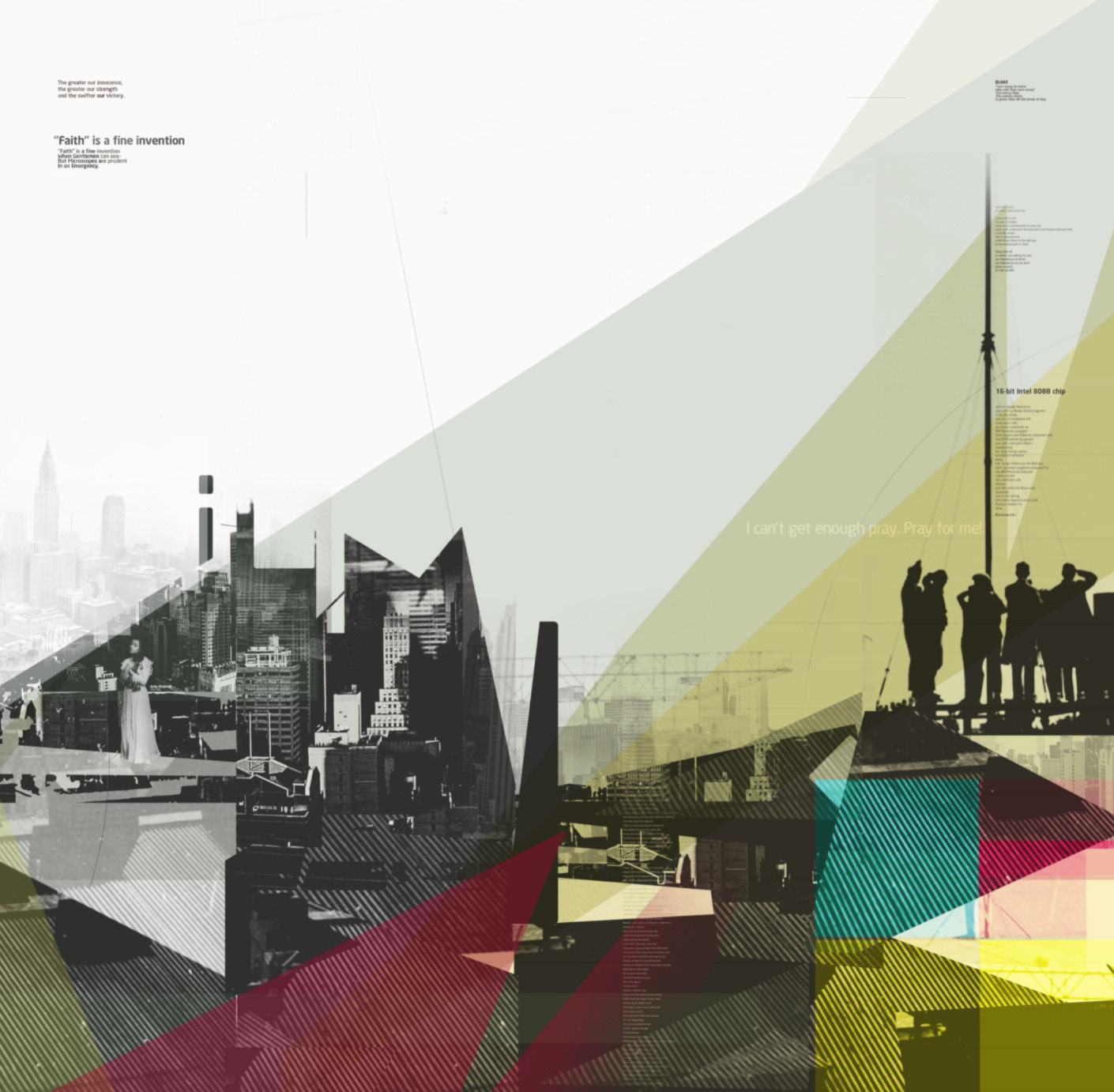
In Faith Is a Fine Invention, urban architectural fragments, human silhouettes, poetic verse, and geometric color fields occupy a shared pictorial surface. A distinct visual cadence emerges between expansive, pale color fields and the dense typographic fracturing below. The eye is denied a singular vanishing point, compelled instead to oscillate across textual fragments, silhouettes, and structural grids.
This layered architecture redirects critical attention away from the software used toward the conceptual dialogue among disparate elements. Overlapping planes elevate certain visual motifs while partially obscuring others. Although typography, architecture, and figuration inhabit the same composite plane, they cannot be deciphered at uniform speed; meaning emerges as the spectator moves between reading text and perceiving spatial form. Project archive
It is instructive to contrast how such an intricate image functions on a glowing display versus a substantial archival print. On screen, magnification isolates details, temporarily severing their syntactic connection to the larger composition. On a physical print, approaching fine detail requires bodily movement through space. Even when presenting identical iconography, these two modes calibrate scale, distance, and intimacy in fundamentally distinct ways.
Thinking Canvas and Code Together in My Own Work
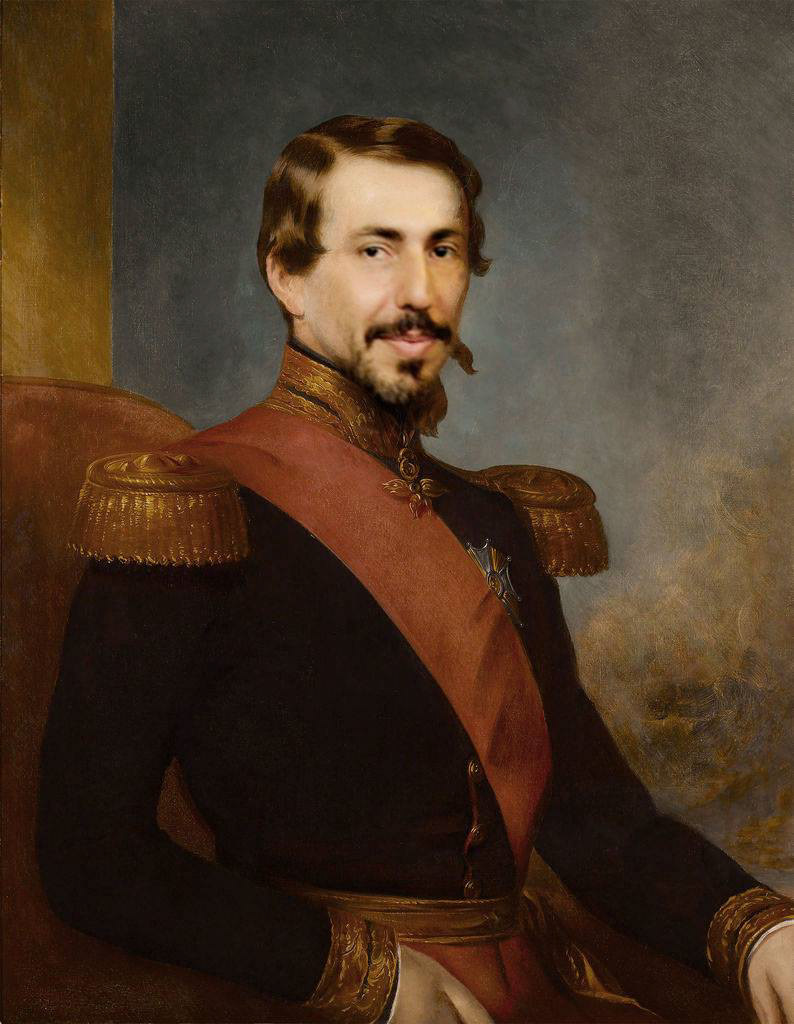
In My Incidental Reincarnations, a distinct artistic operation emerges. By transposing my own contemporary face into historical portraits from diverse cultural epochs, I inhabit codified frameworks of power. The ceremonial uniform, sash, and medals enter into dialogue with the modern countenance. Project record
While Faith Is a Fine Invention orchestrates an abundance of heterogeneous visual elements, this work investigates the semiotic impact of a singular substitution across an established representational framework. Displacing the face renders the societal authority encoded in dress and posture acutely visible. Although both projects may be filed under digital media, the aesthetic operations they perform upon the image remain fundamentally distinct.
I maintain this critical distinction when bringing figurative painting and digital systems into dialogue. Grinding earth and botanical pigments, transposing identity onto historical canvases, and creating an evolving collective portrait with audience participation in Person A do not share identical technical workflows. Rather, the overarching inquiry—how is the human subject represented?—persists across these practices, with each medium illuminating a different dimension of the problem.
In my forthcoming solo exhibition BIOMETRIC, these figurative and computational practices converge within a unified research inquiry. Reading this coexistence through a post-digital lens clarifies not only material divergence, but how the question of human representation mutates across tools. The tactile trace left by organic pigment upon woven canvas and the mutable digital portrait shaped by collective participation compel us to reconsider both the potentials and the boundaries of recording human presence.
Looking at What Lies Outside the Concept
The value of a post-digital reading is demonstrated by the concrete relationships it uncovers. Through which processes does an image travel? Upon which material substrate is it encountered? How do its scale and context shift as it circulates globally? If we cannot answer these questions directly through the artwork, the concept remains an empty taxonomic label.
In both examples examined, historical and contemporary visual idioms collide across the same surface. Yet these works cannot be reduced to an identical visual impact. One emphasizes the circulation across layered fragments, the other the displacement of the face within historical hierarchy. These specific formal differences, which exceed overarching labels, mark the exact threshold where close reading begins.
Thinking canvas and code together demands this nuanced vigilance. Rather than arranging tools in an arbitrary hierarchy of prestige, we investigate which aesthetic judgments each tool renders possible. Our shared critical inquiry deepens not when diverse media provide identical answers, but when they pose provocative, unexpected questions to one another.