Two images placed side-by-side can exhibit striking visual similarity. One may be a carefully curated singular output; the other merely a transient frame extracted from a continuously mutating live system. Inspecting only the final surface does not always reveal this distinction, yet it is profound enough to transform how the artwork must be critically evaluated.
In my digital works utilizing software and machine learning models, I investigate the representation of the human subject. In this research, the question addressed to the computational system is as decisive as the technical medium itself. That a face was algorithmically generated and how that face operates within the aesthetic syntax of an installation must be critically separated.
The role of the artist in AI art can therefore never be reduced to asking whose physical hand authored the final pixels. Formulating the conceptual inquiry, establishing the algorithmic constraints, curating and discarding intermediate iterations, and staging the encounter with the spectator represent distinct arenas of artistic agency. Nor can we assume that all these responsibilities invariably reside within a single individual.
Distinct Practices Under a Single Rubric
A rule-based deterministic plotting script, a self-supervised deep learning neural network, and an interactive installation that responds dynamically to spectator presence do not share identical technical architectures. While they may be discussed together within art criticism, transposing the operational logic of one system onto another rapidly obscures clarity.
Harold Cohen's seminal algorithmic project AARON offers an indispensable historical case study. The Victoria and Albert Museum's accession records describe how the program integrated explicit compositional rules with pseudorandom variables, engineered over decades by Cohen himself. The catalogue entry for a 1973 computer-generated drawing explicitly delineates computational pen-plotting from hand-applied watercolor washes. V&A, AARON and Harold Cohen Collection
This historical evidence demonstrates that finished generative imagery cannot be collapsed into a single act of fabrication. Writing procedural rules, plotting vector contours, and manually applying color operate across distinct aesthetic tiers. AARON's historical methodology cautions against assuming that all contemporary AI systems function through uniform mechanics.
When beginning an analysis of algorithmic art, clarifying terminology is essential. When someone asserts that a machine “created”, “learned”, “selected”, or “decided”, we must ask which exact mathematical operations are being referenced. Anthropomorphic descriptions of automated software behavior do not equate to human consciousness, ethical intention, or lived experience.
The Question Established Prior to the Image
The origin of an artistic process is rarely the initial input prompt. Long before code is executed, a research inquiry, material preference, or spatial staging concept has already crystallized. Why a specific image is conceptually necessary is formulated prior to running software, or discovered through sustained experimentation.
Comprehending this trajectory requires more than memorizing the commercial name of a software library. An identical computational tool can serve radically divergent artistic objectives. One artist interrogates the biometric recognizability of the face; another investigates its geometric dissolution; a third explores public participation. Formally similar visual outputs may emerge from incompatible conceptual motivations.
Artistic decision-making is not uniformly visible across all creative phases. The selected image is presented to us, while thousands of discarded iterations remain unseen. We navigate the physical choreography of a gallery installation, yet remain unaware of alternative layouts considered and abandoned. Process documentation can provide crucial glimpses into these concealed negotiations.
Nevertheless, the mere existence of process notes does not validate the aesthetic merit of an artwork. Generating voluminous computational trials is not equivalent to constructing meaningful aesthetic relations. The conceptual coherence binding the research inquiry, the studio process, and the spectator's phenomenological encounter must be verified directly within the work itself.
Rules as Artistic Raw Material
In his essay The Further Exploits of AARON, Painter, Harold Cohen discusses how he expanded the program's representational grammar to address figure construction, posture, and spatial depth. He details the specific spatial logic and anatomical relations required by software to resolve visual problems. Here, algorithmic code ceases to be an invisible back-end technology and becomes an integral material of artistic thought. Harold Cohen, The Further Exploits of AARON (PDF)
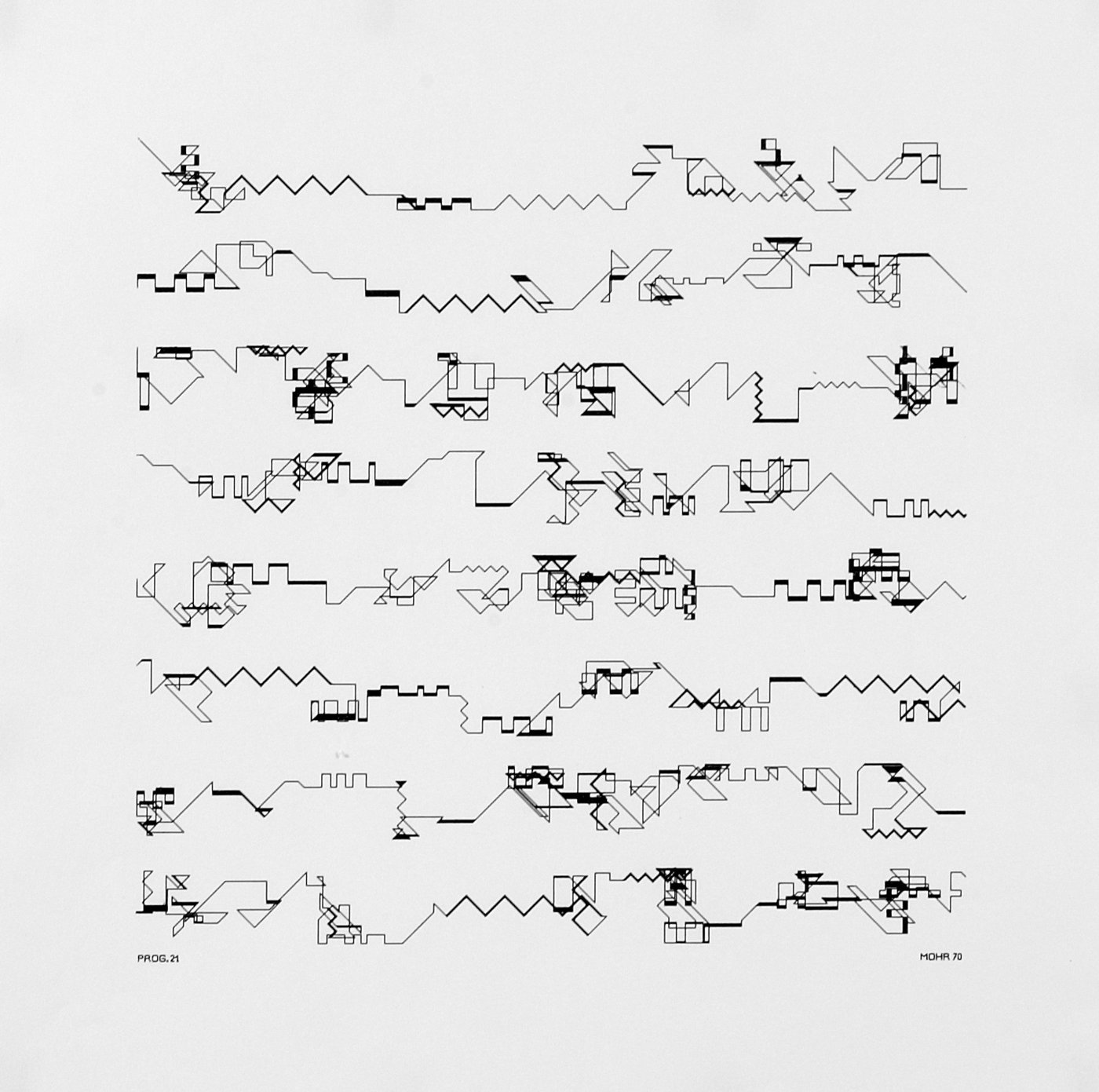
From this precedent, we can conceptualize the role of constraint in contemporary art. If a generative system is restricted to varying within designated mathematical parameters, the deliberate establishment of those boundaries constitutes the core character of the work. When repetition ceases, which elements are permitted to co-occur, and what remains invariant fundamentally shape the resulting aesthetic form.
The presence of strict rules does not banish chance. Indeed, the precise domain in which stochastic randomness is permitted to operate is itself designed. Yet not every random output is inherently meaningful simply because it was unpredicted. The relevance of stochastic outcomes must be scrutinized against the central questions posed by the work.
This perspective proves more productive than partitioning creative production into binary absolutes of absolute control versus complete autonomy. Which variables were strictly defined? Which outputs were left probabilistic? At which juncture did the artist re-enter to curate? Posing these questions enables artistic agency to be discussed with precision.
The Act of Rejection as Equal to Selection
That a machine can synthesize thousands of images per hour does not explain how those images acquire artistic meaning. Deciding to elevate a single frame, compile an edited sequence, or display the output as an uncurated stream represents divergent aesthetic choices. Each choice constructs a distinct encounter for the viewer.
The criteria governing curation can be examined: Was an image preserved solely because of its sensational visual impact, or because it advanced the work's conceptual inquiry? These motivations can coexist. Yet evaluating visual novelty separately from conceptual function prevents leaving the artwork to the mercy of superficial first impressions.
Rejection leaves tangible traces. Studio notes, discarded iterations, and version logs can illuminate why specific trajectories were abandoned. In the absence of such documentation, we cannot fabricate speculative editorial narratives. We analyze the form before us, leaving the rationale behind unseen choices as an open, acknowledged question.
Two evaluations proceed in parallel: What do we empirically know regarding the production process? And how does the final form function both with and without that contextual knowledge? An explanatory statement can illuminate hidden layers, yet an elaborate process narrative disconnected from the visual experience cannot salvage an unresolved artwork.
Collective Faciality in Person A
In Person A, the spectator's facial data is composited with that of previous participants, joining an evolving collective portrait. The project's refusal to freeze the human subject into an immutable identity likeness manifests here. The face confronting the room is not a static portrait of an individual.
Examining this architecture through the lens of artistic agency reveals that collective transformation was embedded directly into the foundational rules of the piece. The spectator actively participates, yet they do not construct the algorithmic apparatus from scratch. The nature of the transformation is pre-determined by the installation's conceptual design.
I deliberately separate technical software infrastructure from conceptual architecture. We can interrogate collective portraiture without reducing the debate to proprietary neural weights or tensor math. Technical parameters should be addressed only with verified documentation.
Audience participation should not be romanticized as a total erasure of the artist. Rather, participation generates a new aesthetic encounter within the parameters designed by the artist. How predictable this encounter is, and how much interpretive agency it affords the spectator, are essential inquiries. The somatic experience of participating in the emergence of a collective countenance is as vital as the final image itself.
Across Which Relationships Can We Read the Work?
When critically evaluating an AI artwork, we should first seek its driving conceptual inquiry. Next, we examine the coherence binding that inquiry to the computational methodology. Had the tool been swapped, would the conceptual core remain intact? Is the system deployed merely as an automated image factory, or does its operational behavior actively inform the meaning of the work?
We must then analyze spatial presentation. A static archival print, a curated video loop, and a live, responsive generative feed produce vastly disparate phenomenological experiences. What the spectator perceives, how long they remain before the work, and what agency they exercise belong directly to the artwork's form.
Finally, we must ask how collaborative labor is acknowledged across the process. The roles of artist, software engineer, machine model, and audience are rarely identical. Transparently articulating these contributions permits the artwork to be critically assessed without attributing supernatural genius either to an isolated artist or an algorithmic black box.
In my own research into human representation, technological novelty is never an end in itself. I focus on how the image is constructed, which politics of identity it embodies, and what it exposes in the encounter with the spectator. Artistic agency resides sometimes upon the visible face, and sometimes within the silent rule that permits that face to dissolve. To read the artwork is to trace the dialogue between the two.