Among the most pervasive oversimplifications circulating across popular visual culture is the myth that Islamic art is monolithically aniconic, an aesthetic sphere confined strictly to calligraphic abstraction and geometric ornamentation. Summarized under the catch-all trope of an absolute "Islamic image prohibition," this claim crumbles before historical evidence, obscuring centuries of extraordinary figurative painting.
In Islamic visual culture, aniconism, the principled avoidance of figural imagery, was observed primarily within sacred ritual architecture: mosques, mausoleums, and liturgical objects. To avert the peril of idolatry, figural likeness was excluded from religious spaces, paving the way for the emergence and evolution of remarkably distinct visual disciplines such as calligraphy, geometric abstraction, and the arabesque. Beyond liturgical architecture, however, across courtly ateliers, princely libraries, medical treatises, and private domestic spaces, figurative representation flourished uninterrupted across centuries.
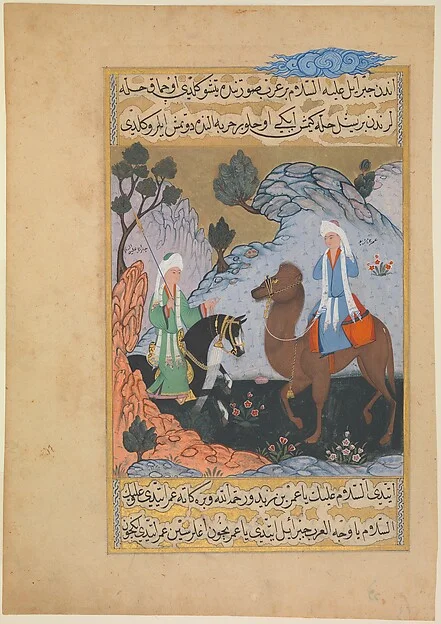
Illustrated manuscripts commissioned by Timurid, Safavid, Mughal, and Ottoman courts rank among the supreme summits of world figurative draughtsmanship. Court manuscripts such as Ferdowsi’s Shahnama, Nizami’s Khamsa, or the Ottoman court’s monumental Siyer-i Nebi and Hünername teem with thousands of expressive figures, imperial portraits, hunting scenes, and intimate lovers. Master court painters from Bihzad and Sultan Muhammad to Nakkaş Osman and Levni cultivated sophisticated anatomical and portrait repertoires.
One of the most arresting, uncanny, and singular ruptures within this heritage, and among the profoundest wellsprings of my own artistic practice, is the enigmatic universe of Muhammad (Mehmed) Siyah Qalam. Transposing the raw, nomadic kinetic energy of 14th- and 15th-century Eurasian and Silk Road steppes into the Topkapı Palace albums, Siyah Qalam breaks radically away from the idealized, lyrical decorum of orthodox court miniature painting. His wandering dervishes, nomads, shamans, and brooding demons (divs) confront the pictorial surface with visceral bodily weight, rugged muscular contours, grotesque physiognomies, and existential unrest. Defying both Western mimetic illusionism and Eastern decorative stylization, Siyah Qalam stands as radical historical proof of how fiercely, uncompromisingly, and expressively the human body could be articulated within the visual memory of this geography.
Recognizing this legacy is liberating for contemporary painters working within or in dialogue with these cultural geographies. An artist misled into believing their heritage possesses no figurative lineage faces a false dichotomy: either aping Western academic mimesis uncritically or resigning themselves to cultural amnesia. In reality, Islamic manuscript painting offers a rigorous alternative to single-point Renaissance perspective: a non-illusionistic pictorial space calibrated through multiple optical vantage points, floating horizons, and chromatic resonance.
In my own painting practice, engaging with natural mineral pigments, raw umbers, and plant dyes, this historical memory remains an active dialogue. The flattened pictorial depth of the manuscript tradition, the intimate relationship between the figure and the surface, and treating the visage not as surveillance data but as a contemplative threshold provide vital conceptual scaffolding for contemporary practice.
Recovering the rich figurative heritage of Islamic art is not merely an archival correction; it offers contemporary painters an indispensable opportunity to speak with an even more powerful visual voice by engaging with diverse, profoundly rich, and exceptionally nuanced approaches.