I Have Only a Text in Hand
For as long as I can remember, I have had a recurring—bordering on 'constant'—issue with exhibition press releases. I cannot understand the phrasing of some, and for others, I wish I hadn’t understood what I did. Sometimes I get thrilled; sometimes I grow anxious.
Perhaps for this very reason, purely of my own accord, simply because I felt like it—and who knows for what other motives—I decided to conduct an experiment. If I really like what I’ve done, or if others take a great liking to it, if heavenly light descends upon me, if I stumble upon gold under my bed base, or if dishes wash themselves at my mere touch, I might attempt a second, third, or even fourth try.
The premise is this: I choose an exhibition, and before setting foot in it, I read its press release. I critique the text with utmost seriousness. (I might drift slightly into the dark side while interpreting, but surely nobody's perfect—a slight flaw is only human.) Then, I visit the exhibition in person. Afterwards, I write down my impressions and assemble the second piece. What did the text make me feel, and what did I actually find in the gallery? All will unfold across these pages.
So that's that. Whether my head reaches the stars or readers slip into a parallel universe, that part I cannot tell. But here I go.
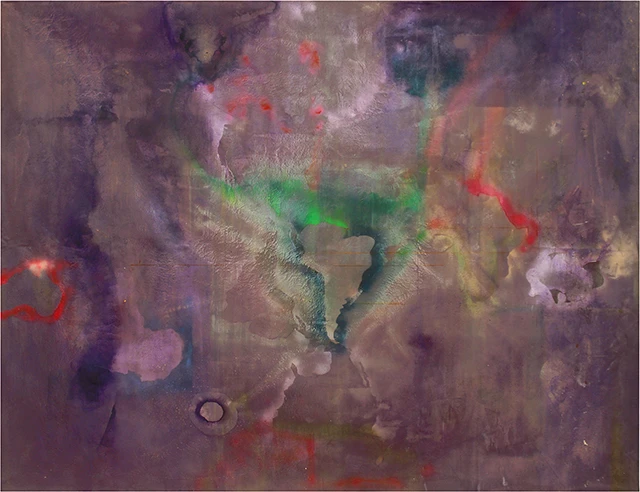
Our first exhibition comes from Pera Museum: Frank Bowling: Creation and Destruction (September 29, 2026 – January 31, 2027). Because why not? Besides, the curator is foreign; the chances of him hearing of me, seeing me, holding a grudge, or falling in love with me are considerably slimmer. So I deemed the conditions quite reasonable for the inaugural piece.
I read the exhibition press release on Pera Museum’s website. I am also leaving the link to the page at the end of the text. As I formulate my review, I am quoting the statements from the text in parts below.
Intersection and Rediscovery
First paragraph
“Bringing together the works of Frank Bowling with those of prominent figures of British art, Francis Bacon and Victor Willing, the exhibition 'Frank Bowling: Creation and Destruction' traces the converging, diverging, and re-intersecting artistic trajectories of the three painters with a focus on Bowling.”
The opening sentence introduces the exhibition as a Bowling-centric gathering. The paths of the three painters converge, diverge, and re-intersect. Yet we do not know where these paths crossed before or what this convergence is grounded upon. As an art enthusiast, are we expected to know, or will we be informed later? We shall see. Could the overarching framework of British art be what is meant? But since that would be overwhelmingly generic, in my view the intention must be something else.
“Curated by Alistair Hicks and presenting Bowling’s works to audiences in Istanbul for the first time, the exhibition approaches the artist’s practice and sources of inspiration along the axes of experimentation, chance, and rediscovery. Across the tensions between creation and destruction, order and chaos, chance and control, painting emerges not as a finished surface, but as an uninterrupted domain of transformation.”
We learn the curator and the geography: curated by Alistair Hicks, the exhibition presents Bowling’s works in Istanbul for the first time. The show is structured around three concepts: experimentation, chance, and rediscovery. I latch onto the word 'rediscovery' (or rather, 'discovery anew'). In the text’s first two sentences, it appears twice. The exhibition implies there is something I ought to know beforehand—as though I must dig up a pre-established relationship or a discovery that had previously occurred. I must not stress out.
In the following sentence, concepts morph into antagonistic pairs: creation and destruction, order and chaos, chance and control. Painting ceases to be a finished surface and is defined as an uninterrupted realm of transformation. Umberto Eco’s 'open work' is the first thought that comes to mind. Immediately after, I am left with this realization: I could utter this exact sentence for almost any artist. What, then, distinguishes Bowling’s practice from others? The press release offers no answer just yet. We must read on.
Memory, Geometry, and Return
Second paragraph
“Having produced work in London and New York for over sixty years, Frank Bowling has pushed the boundaries of conventional classifications throughout his career, moving freely between abstraction and memory, geometry and spontaneity. Bringing together works from different periods of the artist’s career, the exhibition features previously unshown works alongside paintings from his celebrated Map Paintings series (1967–71) and 'Remaking Mother’s House' (2026), in which he returns to the imagery of his childhood home in Guyana.”
At this stage, the text briefly introduces Bowling. My mind immediately darts back to the phrases 're-intersecting' and 'rediscovery' from the first paragraph; I search for their answers.
The artist has been producing in London and New York for over sixty years, pushing the boundaries of established classifications, roaming between abstraction and memory, geometry and spontaneity. The concept pairs from the first paragraph are now expanded with a new list. However, while earlier pairs were structured on contradictions, 'abstraction and memory' or 'geometry and spontaneity' are not kindred couplings. I wonder how these are tied to the artworks.
The next sentence offers tangible substance for the first time: works from different periods, previously unexhibited pieces, paintings from the Map Paintings series dated between 1967–71, and Remaking Mother’s House (2026), returning to his childhood home in Guyana. (I might already love this artwork simply because of its title, even without seeing it.)
There is an almost sixty-year gulf between the Map Paintings series and Remaking Mother’s House. The text does not account for this gap. Whether it represents a progression, a rupture, or a circular return, we cannot tell. For now, all we know is that works from disparate eras are placed side by side. Still, the word 'anew' lingers in my thoughts. The title of the new piece hints at the possibility of a return. Perhaps the rediscovery promised in the first paragraph can be read through the artist's engagement with his own past. But for now, that is merely my interpretation. The text does not explicitly articulate this link.
I also wonder which works are to be exhibited for the first time. For a painter whose works are displayed in Turkey for the very first time, I understand this phrase 'previously unshown works' to be targeted at a global following.
Intervention and the Compass
Third paragraph
“Bowling’s works are accompanied by pieces by Francis Bacon and Victor Willing, which curator Alistair Hicks characterizes as 'interventions.' Described by Hicks as 'compasses helping us find our way through Bowling’s paintings,' these interventions render visible the diverging and converging aspects of the three painters. Bacon’s 'Portrait of Lisa' (1956) and 'Study of a Nude' (1952–53), along with Willing’s 'Head VI' (1985), painted in the final years of his life, create encounters that make it possible to view Bowling’s practice from other perspectives.”
Here, Bacon and Willing step onto the stage. The curator defines their works as 'interventions' directed toward Bowling’s oeuvre. The word 'intervention' is significant. An intervention implies an external effect exerted upon an existing whole. In this scenario, Bowling’s works occupy the center, while Bacon’s and Willing’s works are positioned as elements joining that center from the outside. At least, that is how I understand it.
In the following sentence, these interventions are likened to compasses—such that these compasses will illuminate the diverging and converging aspects of the three painters.
Right at this point, my phobia of exhibition press releases begins to grip my body alongside a climbing pulse. A compass indicates direction; it does not by itself explain divergence or convergence. Why was this metaphor chosen? Am I utterly inadequate? Should I have studied harder in my literary semiotics classes? I feel tempted to summon the ghost of Roland Barthes from the spirit realm. Then I think better of it, worried he might haunt me. Crazy ideas flutter through my mind, but I shall not succumb to this sensation.
Let’s re-read: There are three different artists. The works of two will illuminate the diverging and intersecting aspects of all three painters.
Right. And how, exactly?
The answer becomes slightly more concrete in the next sentence. The curator names specific works by Bacon and Willing, asserting that they enable us to view Bowling’s practice from alternative angles. And the person who must navigate this path is the spectator.
Thus, Bowling’s paintings turn into a terrain, and the other two artists' works into instruments enabling us to navigate that terrain. So the exhibition is not presented as a space to be strolled through passively from right to left. There is a terrain, and there are works by other artists functioning as compasses. Brilliant.
Yet the rationale behind the selection remains elusive. From Bacon, Portrait of Lisa (1956) and Study of a Nude (1952–53); from Willing, Head VI (1985), produced in the twilight of his life, have been chosen. These works will allow us to examine Bowling from different angles (but which angles?) Through which works will the affinities and divergences of the three painters crystallize? The press release does not explain.
Speaking of intellect, I would also like to draw attention to the proportions. Two works from Bacon, one from Willing. This distribution clarifies that the three artists are not represented with equal weight in the exhibition. The exhibition belongs to one of the three anyway. The other two are compasses. Of course, the number of works alone does not determine curatorial weight. However, when the reason why these particular pieces serve as compasses is left unexplained, how the exhibition orchestrates these relationships remains ambiguous—and causes me a bit of stress.
Rethinking and Shared Experience
Fourth paragraph
“'Frank Bowling: Creation and Destruction' opens up for reconsideration the experimental approach that shaped post-WWII British painting, as well as how Bowling transformed this legacy within his own practice. Rather than reproducing established divisions between abstraction and figuration, the exhibition demonstrates that new artistic pursuits emerge from shared experiences and different radical responses to the same fundamental question: What can painting become?”
Of course, the final paragraph could not do without a 'rethinking' (or 'thinking anew').
Frankly, I begin to feel slightly reprimanded. When someone says 'anew', I feel obligated to know what was 'before'; and what’s more, I don’t even know what it is that I don’t know. I know that I don’t know, but I cannot know what I failed to know. What am I supposed to do?
This phrasing could simply mean that we will re-evaluate everything after visiting the exhibition. If that’s all, no trouble; one hardly needs to announce it. In the worst-case scenario, I could think about it before going, think about it once more inside the museum, and thereby have thought about it 'anew'. Crazy questions swarm in my mind once again, but I refuse to surrender.
I forge ahead because, as you have noticed, the text raises the stakes in the final paragraph by anchoring the exhibition in a broader historical ground: the experimental approach in post-World War II British painting and how Bowling transformed this legacy within his own practice. Voila!
Instantly, the initial emphasis on London and New York and the claim that the artist defied established classifications spring to mind. Despite that opening, I cannot help thinking that the text is continuously trying to classify Bowling.
Let’s admit it: I don’t believe the aforementioned tradition has an unambiguous definition either. When someone speaks of 'the experimental approach that shaped post-WWII British painting,' does something distinct instantly pop into everyone’s head? If so, I am clearly not 'everyone.' If not, then I am just like everyone else.
In short, for how many people reading the text on the website can this historical frame genuinely be clarifying? I'll answer: exactly two. But right now, there is something more pressing than who those two might be, because with the final sentence, the text doubles down once more. According to the concluding sentence, rather than reproducing established divisions between abstraction and figuration, the exhibition renders visible different artistic responses born of shared experiences. At this stage, one could accept everything and gain a fortune, or reject everything and lose it all. So let us tread carefully.
This time, for the word 'anew', Turkish pop diva Nilüfer’s lyric rings in my ear: Love me again, newly, anew.
Well... The 'shared experiences' from the very start of the text make a comeback here. I trust you noticed. But returning does not equate to unpacking. These concepts don’t just pass through; they arrive and stay put. Why?
Because placing abstract and figurative works in the same room does not automatically dissolve the divide between them. Positioned side by side, that distinction might become all the more pronounced. The press release fails to explain why these distinctions cannot be reproduced, or how this encounter transforms them.
Conclusion: The Promise of the Text
At the start of the text, an intersection was promised to us. At the end, we are confronted with a question: What can painting become? Between these two, new conceptual pairs, new painter names, and a historical tradition enter the picture.
Tangible elements remain scarce: the Map Paintings series, Remaking Mother’s House, and three works by Bacon and Willing. The nature of the intersection (influence, synchronicity, shared origins, or a resemblance constructed by the curator) is never stated clearly in any sentence. Does the compass help us read Bowling’s paintings, or does it bind the three painters together? This too remains open.
Meanwhile, I counted the word 'yeniden' (anew/re-). It appears five times in the exhibition text: 're-intersecting', 'rediscovery', Remaking Mother’s House (in Turkish: Annemin Evine Yeniden Bakış), 'reconsidering', and 'reproducing'. One of these belongs to the title of an artwork. That means the text itself says 'anew' four times, and uses it once more because of Bowling’s painting.
The distribution is also curious: two in the first paragraph, one in the second, zero in the third, and two in the final paragraph. In the paragraph where Bacon and Willing are invoked, not a single 'anew' appears.
This could well be a coincidence, of course; the text loves chance anyway.
I know that a number alone proves nothing. In a brief text, word repetition can be a stylistic preference or a translator's habit. For me, the issue is less the repetition itself than the premise about a prior state that arises with each use of the word. The text claims intersections, discoveries, and reflections will happen anew, yet leaves the reader on ambiguous ground without elucidating what these transformations actually are. Still, I was the one fixating on this word before even seeing the exhibition. I couldn’t let the count go unmentioned.
Naturally, I do not expect the rigorous evidential structure of an academic dissertation from an exhibition press release. Press releases are a form of invitation. But like every invitation, they make a promise regarding the feast inside. And I shall go to put that promise to the test.
When I go, I will carry three questions in my pocket:
- How is the bond between Bowling and Bacon & Willing actually constructed in the exhibition?
- Who or what is the compass, and who or what is the terrain?
- Does the distinction between abstraction and figuration dissolve, or does it become even more visible when placed side by side? (I mean...)
After touring the exhibition, I will write an evaluation 'anew'.
I will be calmer and sweet as honey.
The exhibition Frank Bowling: Creation and Destruction is on view at Pera Museum from September 29, 2026 to January 31, 2027.
Exhibition link: https://www.peramuzesi.org.tr/sergi/frank-bowling-yaratim-ve-yikim/1323