When you first look at the photograph, it feels as though you are encountering a scene left in the wake of a demolition site: white fragments of concrete scattered across the ground, twisted metal rebar protruding outward, and a heavy sledgehammer resting casually against a wall right beside them…
Yet this is not a construction site. That pile of rubble consists of Canan Tolon’s sculptures, en route to an exhibition in London. In her social media post, Tolon explains that authorities at customs deemed the sculptures suspicious and smashed them with a sledgehammer, subsequently seizing their metal armatures per procedure.
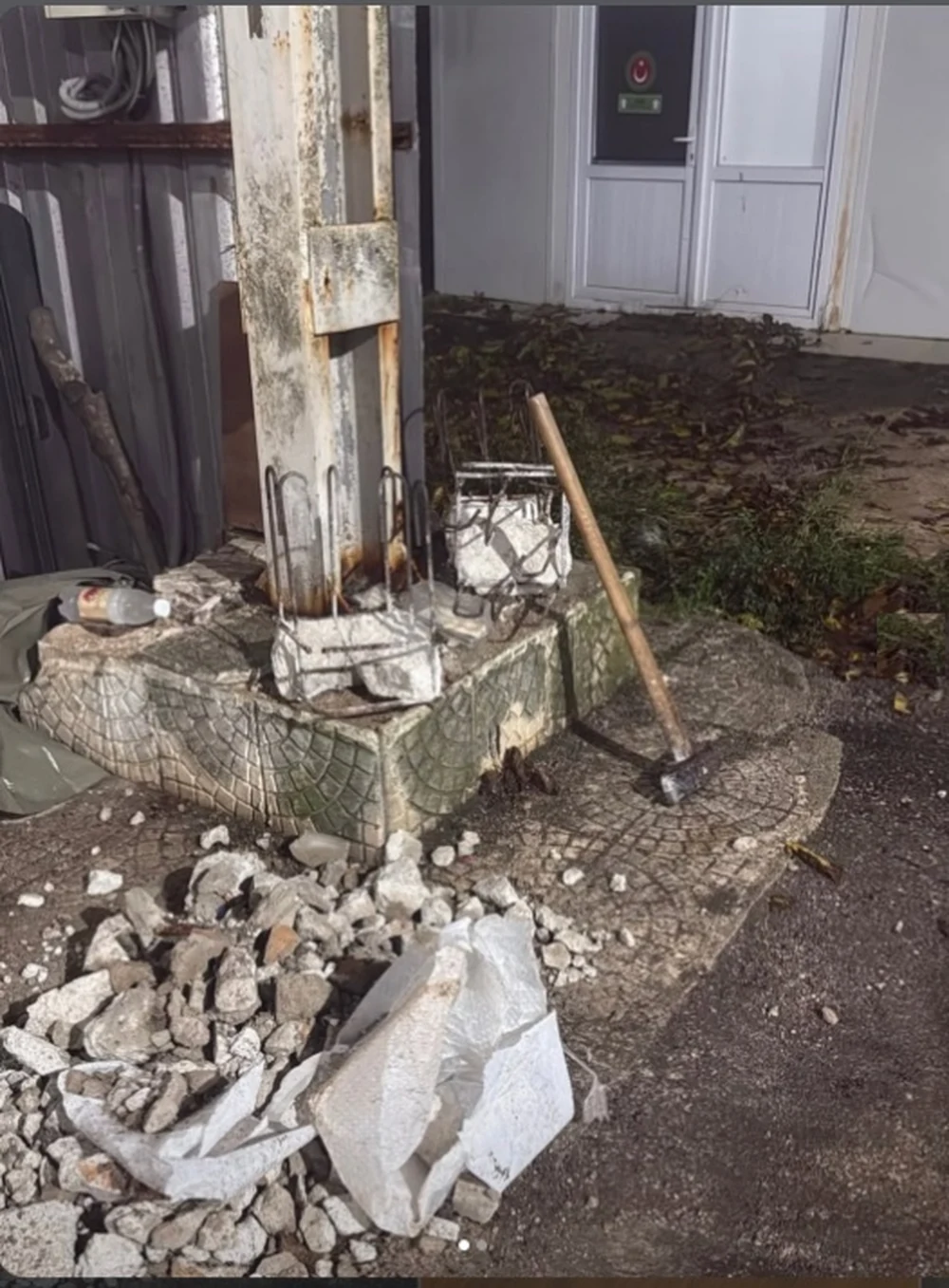
Seeing an artist’s work shattered in this manner is profoundly jarring. One could easily dismiss this as an excessive customs measure, an absurdity, or a glaring bureaucratic blunder. Yet for me, the incident raises a far more fundamental question:
What does an inspection system do when confronted with an object it cannot explain through its own rules? Does it seek to understand it, or does it resolve to eliminate it?
The Unclassifiable Object
Encounters between works of art and customs or security inspections are hardly unprecedented. In 1926, when Constantin Brâncuși’s sculpture Bird in Space was shipped from Paris to New York, U.S. customs refused to recognize it as a work of art. The prevailing artistic sensibility of the period demanded that sculpture recognizably imitate objects in nature. Brâncuși’s work, which gave form not to the visual likeness of a bird but to the very concept of flight, failed to satisfy this criterion; it was classified as manufactured metalware and subjected to import duty. In the lawsuit brought by the artist, the court ruled in 1928 that modern sculpture is under no obligation to imitate nature—indeed a watershed moment!
What happened in 1989 to a metal sculpture shipped from the UK to the U.S. by collector Gene Locks followed a different yet related path. The work, composed of three welded metal vessels, was subjected to intrusive inspection due to its unusual weight. When the sculpture proved too large for the local X-ray apparatus, officials drilled holes into its base and cut away the top portion of one vessel. By the time it was determined that there was no contraband—and that the weight was simply due to sand inside the vessels—the artwork had already sustained irreversible damage. The incident later entered judicial records.
What unites Canan Tolon’s case with these two historical precedents is an inspection mechanism that cannot account for the object before it using its existing categories.
In his book Seeing Like a State, political scientist James C. Scott examines how modern administrative systems simplify the world in order to render it legible and manageable. Real life is intricate, fluid, and filled with divergent particularities. Yet for states and large institutions to function, this heterogeneity must be divided into categories, quantified, and recorded. Forests are reduced to timber volume, citizens to identification numbers, and cities to maps and cadastral grids. In this way, complex reality is translated into an orderly, manageable scheme.
Customs inspection operates on a similar logic. Every object is expected to be identifiable, measurable, and verifiable. A work of art, by its very nature, rarely fits neatly into these boxes. It cannot be reduced merely to its raw material or its physical dimensions.
When Inspection Suppressed Comprehension
Michel Foucault demonstrated that modern power operates not solely through prohibitions and punishments, but by observing, classifying, defining the normal, and bringing everything outside that norm under supervision. In the customs yard incident, we witness a direct manifestation of this logic: when an object fails to conform to established classifications, rather than seeking alternative avenues of understanding, it becomes expedient to relegate it to the realm of suspicion.
To be sure, security concerns at customs are entirely understandable. Illicit contraband can indeed be concealed within concrete and metal, and verifying this is the duty of inspecting authorities. Yet security needs do not confer unbounded authority to destroy. The inability to render an object's interior visible does not inherently justify its destruction. Moreover, alternative avenues were readily available: verifying the shipment with the artist or the hosting gallery, consulting an expert, or employing non-destructive inspection techniques. We do not know whether any of these were attempted. What we do know, according to Tolon’s account, is that the sculptures were smashed and their metal armatures confiscated. And herein lies the core problem: security suspicion cannot nullify the institutional responsibility to preserve the integrity of an artwork.
An Artist Confronting Her Own Inquiry
What renders the situation even more poignant is the relationship between the incident and Canan Tolon’s artistic practice. For decades, Tolon has investigated concrete, rust, building materials, urban environments, and human interventions upon nature. Themes of construction and deconstruction, establishing order and the unraveling of that order, occupy a central place in her oeuvre.
This time, the destruction the artist has long contemplated was enacted upon her own works. Yet it would be a mistake to romanticize this as an ironic coincidence aligned with her practice. This was not an intentional artistic intervention chosen by the artist, but an external, irreversible act of damage inflicted upon her work. A question opened to dialogue by art manifested as literal, physical violence against art itself.
Must Everything Be Transparent?
Caribbean philosopher Édouard Glissant formulated the concept of the 'Right to Opacity' (droit à l'opacité), arguing that an individual or a culture should not be obligated to be entirely transparent, explained, or decipherable to others. While Glissant framed this primarily in the context of human and intercultural relations, the boundary he articulates provides profound resonance when thinking about art. To understand something does not require stripping away all its mysteries or rendering it wholly decipherable.
The value of a work of art often stems precisely from its resistance to singular explanations. We may not immediately resolve why a form was constructed in a specific way, why a material was chosen, or what the piece definitively means. Often, what endows the artwork with enduring power is precisely this unresolved ambiguity. Far from a defect requiring remedy, this ambiguity is integral to our relationship with art. An inability to see through an object does not render it guilty.
What befell Canan Tolon’s sculptures should not be dismissed merely as an excess of customs enforcement or a bureaucratic absurdity. The incident illustrates what is forfeit when the imperative to control supersedes critical judgment. What truly makes a system secure is not its capacity to violently force every object into visibility, but its wisdom to know when to pause and seek another path.
The sledgehammer in the photograph is thus not merely a tool resting beside broken concrete. It is the emblem of an approach that attempts to resolve what it cannot comprehend by shattering it. Canan Tolon’s sculptures were destroyed. The lingering question, however, extends far beyond this single episode:
Can an inability to comprehend ever serve as sufficient justification to destroy?