Over the past decade, art spaces along the axis spanning the world's leading cultural capitals to Istanbul have undergone a radical existential mutation. Institutions that once stood as sanctums of silence, intellectual confrontation, and suspended time—veritable sanctuaries of reflection—have today transformed into adult amusement parks characterized by sprawling ticket queues, timed-entry slots, and spaces meticulously engineered to feed Instagram feeds. Celebrated within museum management literature under the polished banner of the "experience economy," this shift exposes a severe paradox in contemporary art: while the number of people entering museums has multiplied like never before in history, the number of viewers genuinely confronting an artwork, pausing to reflect before its presence, seems to be collapsing.
So, let's dance.
Paintings That Step Inside Us
The foremost packaging of this transformation is the "immersive experience" format that has besieged museums and independent art spaces in recent years. Digital simulations projecting the brushstrokes of Van Gogh or Monet across cavernous floors and ceilings, infinity mirror rooms whose cloying sensation now rivals Dubai chocolate-stuffed baklava eclairs, cascading LED curtains, or colossal inflatable sculptures make an alluring promise to the audience: “Don't just be a spectator of art; step inside it.” Yet, the reality concealed behind these stagings is the exact opposite of what is promised. The viewer does not step inside the art; on the contrary, art is demoted to a cheap decorative filter, a "selfie trap" designed to amplify the viewer's own narcissistic digital image on social media. That constitutive, fraught distance between object and subject evaporates, replaced by an instantaneous burst of visual dopamine.
Indeed, for some time now, the supreme benchmark of 'good' art has been the volume of dopamine it triggers. Because why wouldn't it be.
Turning One’s Back to the Artwork
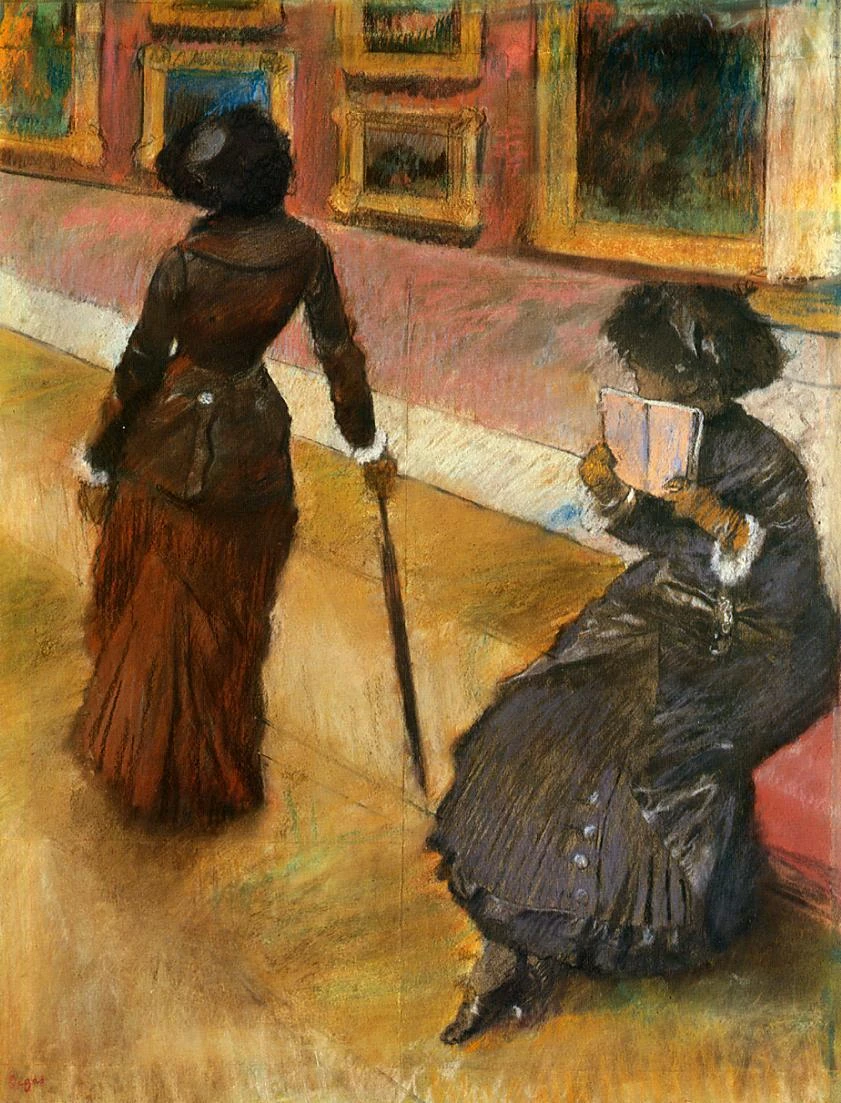
In my view, the most tangible symptom of the museum's descent into an amusement park is traceable in the bodily posture of the visitor inside the exhibition hall. When we examine Edgar Degas's 1880 masterpiece Mary Cassatt at the Louvre (The Paintings Gallery)—one of the most subtle portrayals of museum-going in art history—we witness an entirely different world. In Degas's pastel, the painter Mary Cassatt stands leaning upon her walking stick or umbrella, her back completely turned to the artist and the outside world, fixing her gaze resolutely upon the paintings lining the wall. Beside her, her sister studies the exhibition catalogue. In this posture, there is no affectation, no performance staged for an external audience. There is solely an absolute, concentrated, and silent dialogue forged between the beholder's eye and the painted surface.
What, however, is the universal bodily gesture we witness across contemporary art museums today? It is "turning one's back to the artwork." People no longer position themselves before a painting to meet its gaze; they turn their backs, open the front-facing camera of their smartphone, and place their own face at the dead center of the frame. The artwork is granted value only insofar as it serves as an aestheticized, blurred backdrop. "I looked, I was shaken, and I reflected" gives way to the digital validation of "I was there, I captured it, and I shared it." While the act of seeing collapses, the velocity of the spectacle crushes the contemplative weight of thought.
Box Office Pressure and Contemporary Art Spaces in Turkey
In the proliferation of this spectacle culture, not only the digital habits of the audience but also the market logic embraced by museum leadership and corporate boards are decisive. Today, for contemporary artists and curatorial circles in Turkey, the central tension occasionally knots right at this juncture. In an environment where private museums and foundation structures are increasingly corporatized, and where institutional success is graded strictly on "box office revenue" and "social media engagement metrics," institutions tend to shy away from demanding, patient, politically or ontologically challenging works. In their place, corporate-sponsored "interactive carnivals" fit for photo-ops beneath sponsor logos are preferred. Contemporary art has, for some time now, positioned its spectator not as an intellectual interlocutor, but as a demographic of consuming customers.
The Quiet Resistance of the Canvas and the Figure
Naturally, authentic art wields an ancient resistance that refuses to surrender to the loud lights and cheap thrill of the amusement park (take my figurative paintings, for instance :). An artwork does not necessarily have to suck the viewer in. On the contrary, the work can even erect an insurmountable physical barrier between itself and the spectator (see: Acute Angle). It may not offer you a selfie backdrop; it might test your gaze against your own face, your own memory, and the inescapable gravity of human existence. (After writing that sentence, I tested myself too, but never mind—what's said is said).
The only force capable of resisting the funfairification of art spaces is this uncompromising confrontation that refuses to entertain the viewer, leaving them once more alone with the very contemplative silence they fled from.
Use your dopamine properly.