Walking Into Pera with Three Questions in My Pocket
If you remember, at the end of the first essay (see: Exhibition Press Releases and Me), I made myself a promise: after visiting the exhibition, I would be calmer and as sweet as honey. I had also tucked three questions into my pocket:
- How is the bond between Bacon, Willing, and Bowling established in the exhibition?
- Who or what is the compass, and who or what is the territory?
- Does the divide between abstraction and figuration truly dissolve, or does it become all the more visible when brought side by side?
Walking through the doors of Pera Museum, my intention was to interrogate these very points. Free of preconceptions, I was determined to trace that "grand intersection," the "compasses," and the "rediscoveries" promised on the curator’s website.
From the moment I stepped into the exhibition gallery, I must say something rather curious happened. I had hoped the chasm between that pompous promotional text on the website and the painted surfaces standing before my eyes would close, but in fact, quite the opposite occurred. In my view, the exhibition in the curator's mind and the exhibition hanging on the walls were not speaking on the same frequency. Rather than an intersection, what emerged was more like two separate parallel universes coexisting side by side in the very same room.
Who Lost the Compass?
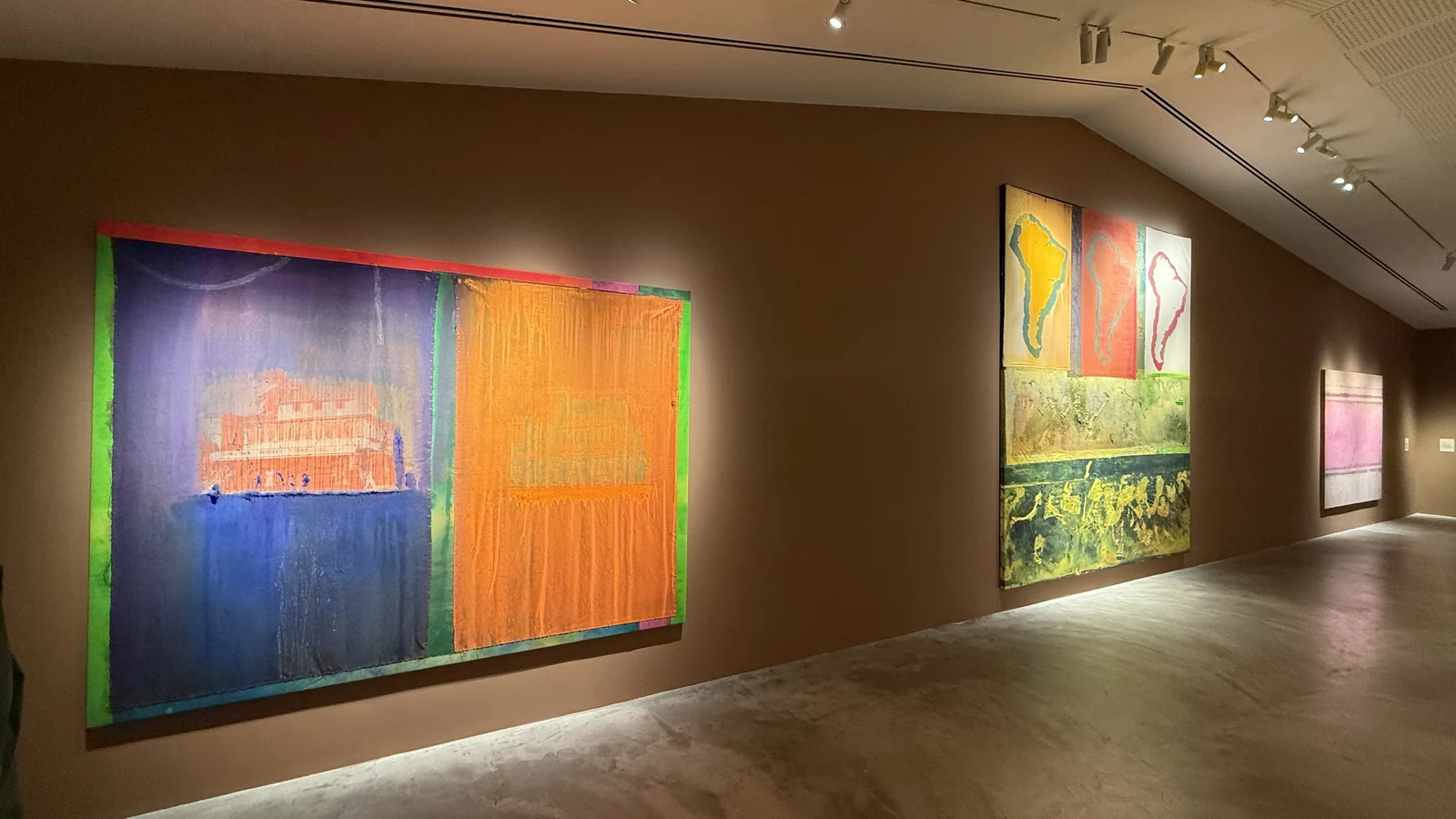
At the entrance, the exhibition title greets us in monumental letters across the wall: Creation and Destruction. Beneath it sits the English subtitle: “With Interruptions by Francis Bacon & Victor Willing”, translated into Turkish as “Francis Bacon & Victor Willing Müdahalesiyle” (With the Interventions of Francis Bacon & Victor Willing).
The press release had told us that these two painters served as "a compass helping us find our way" across Bowling’s abstract terrain. Reading the wall text inside the gallery, I confess things become a bit clearer. When Bowling and Willing were students, Bacon was the undisputed sovereign of London’s art scene. Both had once longed to be within Bacon’s orbit, only to rebel against him later. In fact, Bacon regarded Bowling’s departure from figuration into abstraction as crossing over into "Clement Greenberg's camp" and an outright "betrayal" of painting—talk about an attitude!
Now I pause and reflect: into a retrospective of an artist who fell out with his master, left the house, fled his figurative oppression, and took refuge in the color fields of New York, is placing that very master as a "compass" really such a good idea?
If this is a compass, it says to the viewer less about finding one's bearings and more: “Look, here is a monumental abstract painter, yet without knowing Bacon, you cannot possibly appreciate this man on his own terms.” Unless you are intimately versed in the Royal College of Art corridor gossip, Slade rivalries, and Greenbergian factionalism of British art history, that compass merely spins uselessly in your hand—a decorative ornament pointing neither North nor South. Pardon me: it might become one.
Worlds Standing Side by Side Without Cancelling Each Other Out
As you proceed through the gallery, the curator’s grand thesis—namely, that “settled dichotomies between abstraction and figuration are dissolved”—falls entirely flat.
On one wall hang Francis Bacon’s Study for a Nude (1952–53) and Portrait of Lisa (1956). Bacon’s figure, imprisoned within that iconic transparent chalk cage, writhes as flesh, bone, and an existential scream. There is a dark, claustrophobic, and merciless gravity in the room.
Just a few steps away stand Frank Bowling’s colossal Map paintings, and that famous canvas whose title I had fallen in love with before even seeing it: Reminiscing at Mother’s House (1970). A vast ocean of color, where purple and deep navy pour on one side, cantaloupe and yellow cascade on the other, with the faint silhouette of his childhood house in Guyana hovering like mist in the center.
Now let us return to one of our initial questions: When these two worlds meet side by side, does the boundary between them blur, or does it become more visible? Yes, it becomes undeniably more visible. Insofar as Bacon is a dark figure contracting inward, seizing the viewer by the throat, Bowling is an expanse overflowing outward, washed in the light of the New World, breathing with matter and serendipity.
And here is the finest part: these two paintings do not crush one another. Neither cancels out the other, neither "intervenes" to transform the other; each stands proudly upon the wall in its own existential gravity. Free from the artificial theoretical clash promised by the press release, the exhibition unfolds far more serenely and spaciously on its own terms.
A Cow’s Head and Stepney Hallucinations
One of the details that brought the biggest smile to my face in the exhibition was Bowling’s early Cow’s Head (c. 1960). Before Bowling had ventured out into the boundless waters of abstraction, he painted a severed, bloody head resting on a table. Clearly, in those years, he too had taken his share from Bacon’s butcher-shop aesthetic. Yet this is no "compass"; in my view, it is the naive testament of a young artist emulating his master only to rapidly diverge from him.
Victor Willing’s paintings, meanwhile, form the most modest and touching corner of the exhibition. Beside the text recounting his exhaustion in his Stepney studio, where holes and hallucinations began dissolving the walls, stands a sheltered wooden cabana on desert-yellow terrain (Knight Errant), a solitary armchair, a blue cube, and a potted plant with drooping leaves in the corner. Willing possesses neither Bacon’s violence nor Bowling’s exuberance of matter. On the threshold of illness and exhaustion, he constructs his own interior space. To position him as a mere "device" or "wayfinder" feels rather unfair to Willing’s fragile silence. But credit to the curator: their heart must not have had the cruelty either, as Willing was permitted to live almost entirely apart from the rest of the exhibition, happily nestled within his own world.
The Red Cardboard Frame on the Wall
Wandering through the gallery, I noticed a small red cardboard frame prepared on the wall for children or interactive visitors, accompanied by a prompt:
“Frame just one detail. When you look at it independently from the work itself, what does it resemble?”
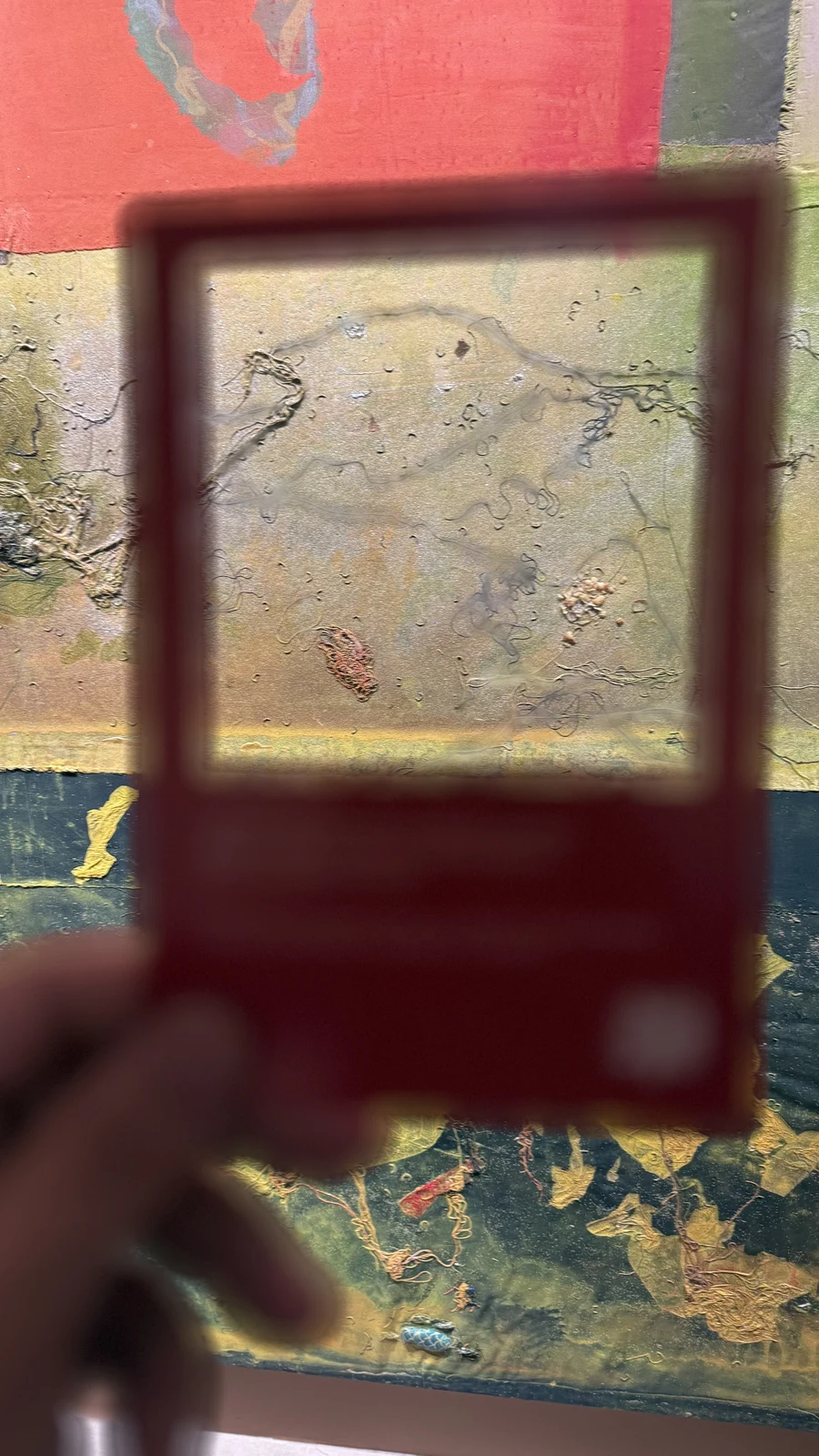
I picked up that red frame and held it up against the dried paint crusts, the stitching threads embedded into the canvas, and the dense layers of Bowling’s monumental map painting. Beyond all the grand curatorial theories, British postwar painting theses, and talk of "interventions" and "compasses," that was perhaps the most honest moment of the exhibition: a solitary stain of paint resting upon canvas. Such paint marks have always been like mirrors to me—not reflecting what is readily seen, but gracefully revealing what has been forgotten.
Conclusion: Paintings Left in Peace
Leaving the exhibition, I had found the answers to all three questions in my pocket:
- How is the bond established? Not through an organic or revolutionary synergy as written in the text, but through the unavoidable biographical friction of having inhabited London during the very same era.
- Where is the compass? There is no compass, thank goodness. Each artist has staked out their own territory, walking their own solitary path. When you enter the gallery, simply turn right and keep going.
- Does the divide between figuration and abstraction dissolve, or become more distinct? No, the divide does not dissolve. Does it become even more pronounced? Yes. The figure remains the figure, the abstract remains the abstract. Yet there is no harm whatsoever in having them stand side by side.
When I read the curator’s text, I felt as though I had been promised an intellectual thriller; yet what I encountered in the gallery, I must confess, was a far more humane, far more refreshing painting exhibition. You truly need to leave an exhibition alone with your own eyes and feelings. Especially when a curatorial text fails to fully reach you, moving past it without getting bogged down and listening to what the artworks themselves say is one of the best things to do. Because paintings are always so much smarter than the texts written about them.