For some time now, I had been feeling the exhaustion of artworks that refuse not to be liked, and consequently force you to like them. Digital works on gigantic screens glow identically everywhere with a copy-paste logic. In painting and sculpture, the same race continues: big, bigger, biggest. If a work doesn’t fit into a hall, this alone is now hailed as a virtue. Last year, or at the beginning of this year, we witnessed an exemplary case of this at Feshane. We all experienced together that piecing together huge components does not automatically yield great art. But in a viewer whose eye hasn't seen and processed enough, fascination grows in tandem with the physical scale of the work. You see a sculpture the size of a building and say, "how beautiful." Yet perhaps the truest thing to say is merely "how huge." Everything that tampers with our measuring ruler creates a tremor, and we cannot always easily distinguish whether that tremor is art.
Perhaps that's why I liked Nermin Ülker's sculptures. Granted, I couldn't put them in my home either; they take up quite a bit of space. But there is no direct relationship between the space they occupy and their state of being art. I cannot easily warm up to a sculpture that speaks for itself by crushing the spectator with its magnitude. If a sculpture is to communicate through sheer size, let it be as tall as a skyscraper; only then will I reconsider my verdict.
Let us return to the exhibition. The poster hung by Black Light Gallery—on the first floor of Fransız Geçidi—in the passage was not the kind that shouted loudly to summon me. Unless you paid sharp attention, you could easily walk right past it. The film El ser querido, which I had watched the day before, had bruised me quite a bit. I was somewhat vulnerable, and I suppose that's why it wasn't the poster itself, but the phrase upon it that caught me in that state: Monuments to sentences that could not find their place.
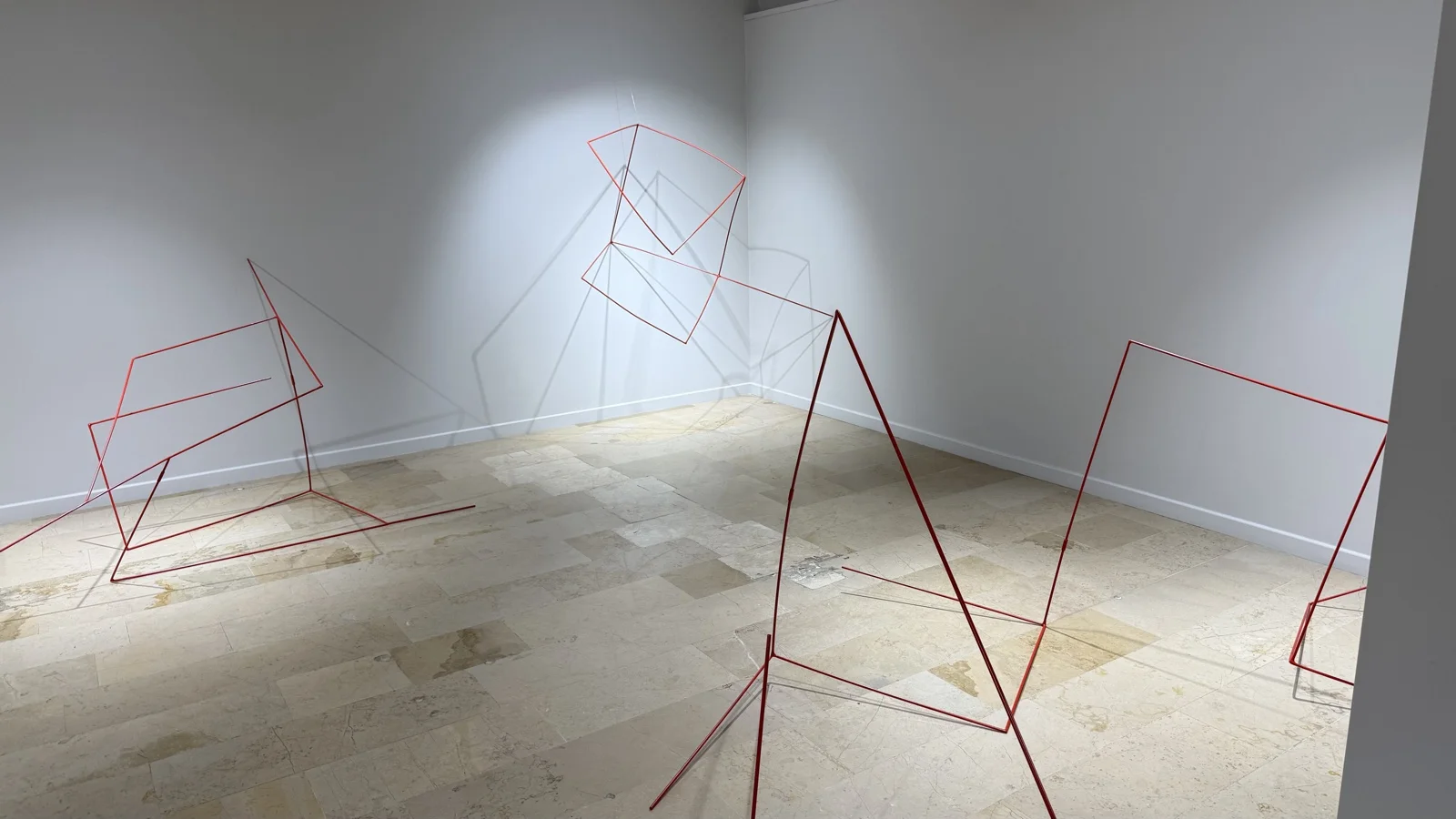
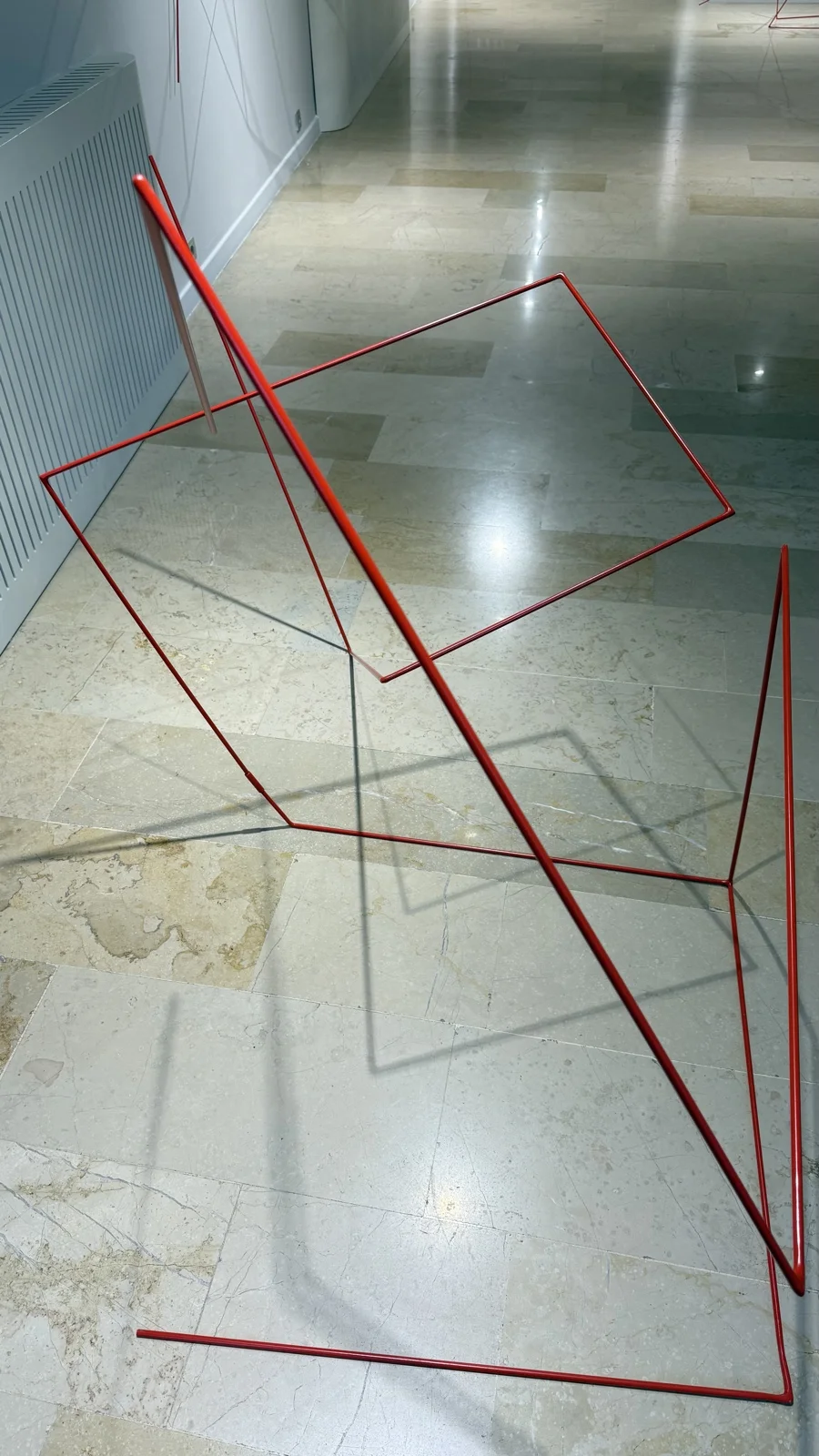
Inside, there were sculptures made of slender metal profiles painted in vivid red, drawing lines in the air and breaking into angles. When sculpture is mentioned, the first thing that comes to mind is typically mass filling a space. Here, on the contrary, we have a linear structure framing the void, resembling three-dimensional charcoal drawings. No form closes completely; lines hang suspended in mid-air just as they are about to attain a complete geometry, or stretch parallel to the ground only to cut off abruptly. The grey shadows cast by the spotlights onto the white walls and polished floor place a ghostly, faint trace beside each sculpture. Normally, a shadow is a kind of twin of the object, but here it is different—as if each sculpture had painted its own picture. As you move through the space, lines that seem like a closed box that you think you can name, disperse two steps later and open into the void. Light, dynamic, almost cheerful pieces. I say 'almost,' because looking at these sculptures, rather than their lightness, I thought of reconfigured iron bars, of a prison. And it is from here that I will continue to narrate the exhibition. So we part ways here with those expecting a purely formal plastistic reading, and walk arm in arm with those longing for deconstruction. An artwork belongs to the spectator as much as it belongs to the artist; so why shouldn't this reading -too- be just as valid?
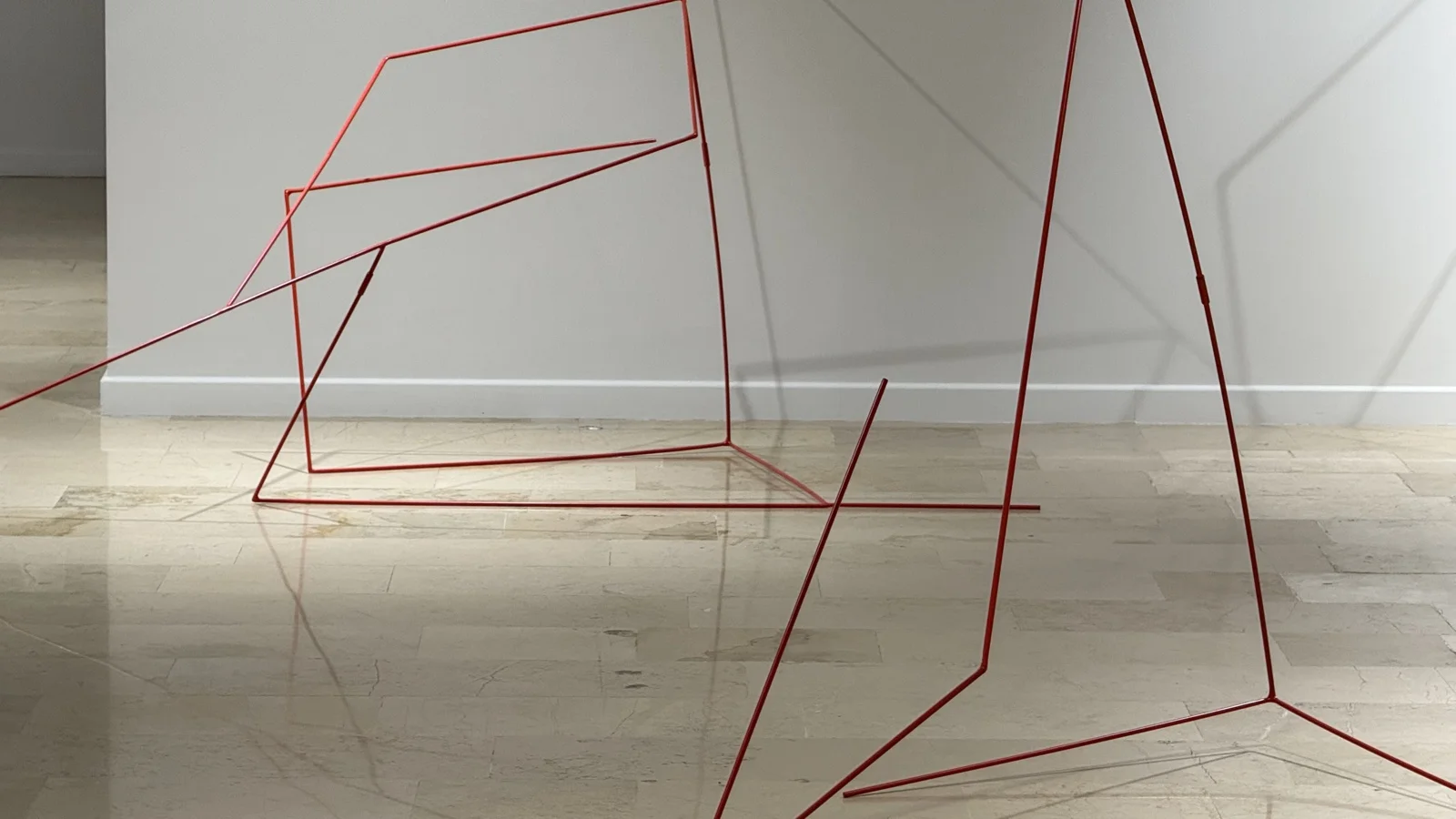
You know the prison visits known as 'closed visitation' (kapalı görüş), or you've seen them in a film. A pane of glass or a similar divider separates the detainee and the visitor; no physical contact, such as hugging or holding hands, takes place. The conversation occurs in a dedicated booth where correctional officers can see and hear. (I copied this explanation from Google; let's not start spinning tales right away.)
A similar condition exists in the exhibition. The sculptures are not hidden, nor are they set atop pedestals to distance them from us (from an interview about the exhibition). In fact, some give the feeling that one could walk right through them with their lines and apertures. Our gaze is free, but our mind and body are not, because despite all the openness and the sense of spacious relief created by the shadows, the asymmetric balance of power between iron and human flesh stands there in all its might. The prison has been dismantled, yet the state of detention persists. Only the form of the relationship has changed over time.
A prison operates bidirectionally. Those inside receive restricted news from outside, and those outside receive limited news from inside. What is enclosed in this exhibition is a fragment of the past (according to an interview I read, childhood). In the exhibition text, this fragment is designated as 'sentences.' Starting from here, Turkish offers a fascinating cluster of vocabulary: Sır tutmak (to keep a secret), tutuklamak (to arrest), tutsak (captive), sözünü tutmak (to keep one's word)… the binding nature of words spoken and unspoken. Lafı bağlamak ('to tie up the discourse') evokes ropes and knots. Lafın lafı açması ('one word leading to another') suggests that silenced words are not an amorphous heap, but a chain. If you unlock one, the rest follows. I found it intriguing that the title uses both 'sentences' and 'monuments' in the plural. A verdict has been rendered, or a sentence has been passed upon something. There is an affinity between the word and the essence of the works that I haven't fully clarified, yet felt—and hopefully managed to make you feel as well. The fact that the forms seem drawn with a pencil is another manifestation of this word/language connection. That is why the shadows of the sculptures, as I noted earlier, are not perceived merely as their twins, but create a palimpsest effect.
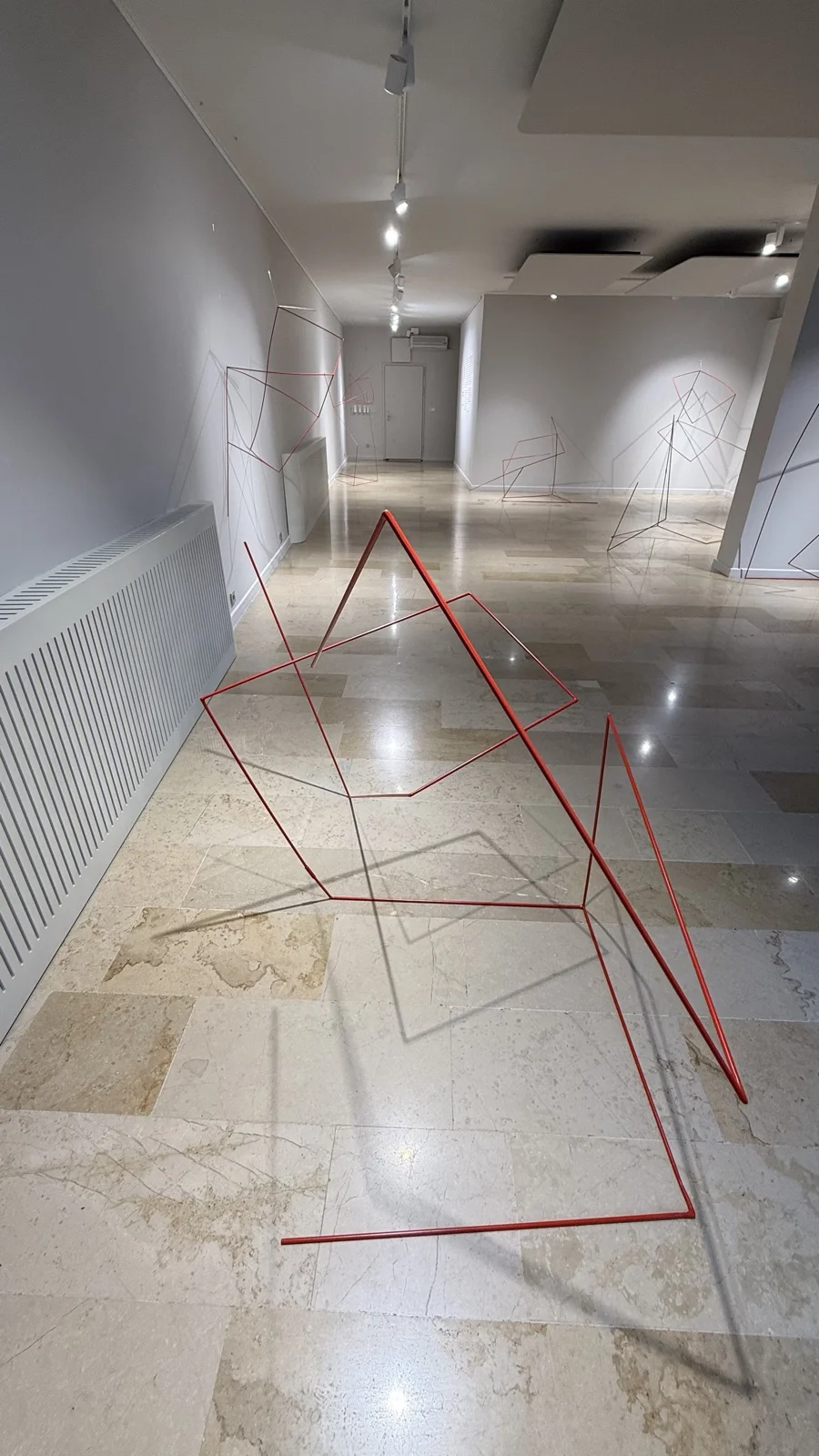
The title of the exhibition derives from Salâh Birsel's only novel, published in 1961 (Dört Köşeli Üçgen - The Four-Cornered Triangle). A book I read very long ago. When I saw its title back then, I thought it was a riddle and solved it in my own way; that is how I remember it. I will return to this at the end of the text. The novel's protagonist is a night watchman who faces backlash from everyone around him simply because he speaks openly about whatever he sees.
What could giving the name of such a novel to an exhibition signify?
The first thing that crossed my mind was confession:
“I hid all my sentences so as not to be punished.”
The second was testimony:
“I saw everything, I know.”
Yet this testimony does not quite amount to a confession. For even if the possibility of recounting is present, the determination to remain silent still endures. I read an interview conducted with the artist on Aposto. She explains that from the age of eleven she stayed in boarding school for many years, learning there which words she could utter and which ones she had to keep to herself. ('Learning' is an interesting word choice.) Then she forms this sentence: “Sometimes a person internalizes external pressure and becomes their own censor.”
In Foucault's panopticon, the prisoner never knows whether they are being watched or not. This uncertainty compels them to internalize the gaze, eventually turning into their own sentinel. Even when surveillance ceases, the human habit of self-policing does not end. What may be spoken, what must be concealed, and which conduct is acceptable become the individual's own truths. There is an affinity here with the process Gramsci describes through hegemony and consent. Still, I will be cautious when using the word 'consent.' To regard an eleven-year-old child's compliance with boarding school rules—especially learning to self-censor within that compliance—as a freely made choice is difficult for me to accept.
Ülker states that veiling is a way of protecting the word, its privacy, and its boundaries. The title of the interview concentrates on precisely this point: “Sometimes the way to express is to leave it incomplete.” In an age where everything is exhibited with ostentation (a tip of the hat to Godard) and the discourse of 'transparency' forces us all into confession at gunpoint, I see presenting the existence of the word while withholding its content as a shrewd strategy. There I go making grand pronouncements again; may my fate be kind.
The only work in the exhibition that breaks the order (or should I say, confirms the accuracy of my prison idea to myself) stands on the balcony. The curator remarks that the work couldn't fit inside and climbed onto the facade facing the street. I, on the other hand, think these pieces are sentences attempting to escape from prison. In a prison, the functions of door and window are distinct. The door is for permitted passage. The window is for light and gaze. Attempting to pass through it—whether to escape outside or to sneak in—is a breach of the rules. I still struggle to decide whether the piece clinging to the facade is an escape or an attempted infiltration. Perhaps both are valid simultaneously. After all, we live in quantum times; the superimposed state of two probabilities is entirely acceptable.
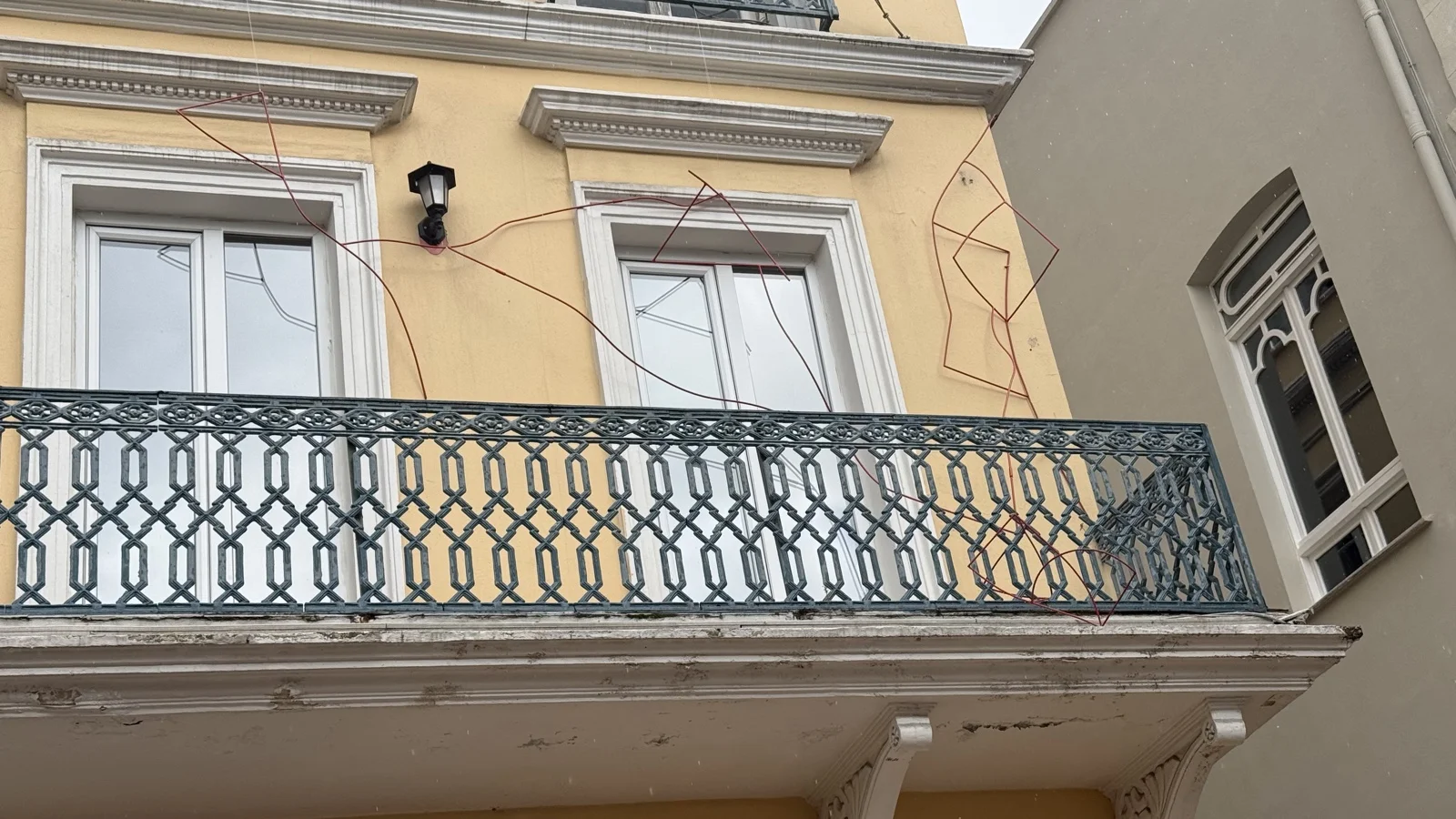
The titles of the artist's previous exhibitions describe the same path: Penceremden (From My Window), Pencereler (Windows). A gaze that doesn't enter the house through the front door, but arrives through an improbable path. Or the safest way of looking outward. A window, while guarding the boundary of remaining inside, simultaneously offers the possibility of establishing a relationship with the outside. One could transition from here to framing theory, but I won't. Because why not. What I will say is: go and see the exhibition before it closes. There are many exhibitions in Istanbul, but not that many where you can walk through without getting slapped in the face, where the conversation is good, and from which you can leave feeling lightened inside. I may have recounted a prison movie, but the movie ends with a happy ending.
Returning to the novel that lends its name to the exhibition (spoiler alert), the protagonist eventually finds himself in a psychiatric hospital. Once again confinement, once again a (kind of) prison. (Turkey, twelwe points)
Now let us come to the puzzle (in my view) in the title of the book. My answer was that the four-cornered triangle was a pyramid. Don't say 'what's the connection?' When you look at a pyramid from the side, you see a triangle; when you look from above, a four-cornered structure emerges. The pyramid is one of the greatest monuments left to us by a magnificent civilization (you have just read the most textbook sentence of this essay). But let us not think of it merely as a funerary monument. The pyramid is a structure that fixes the boundary between the interior and the exterior. It imprisons within itself the mortal body, death, and the faith in eternal life. It draws an insurmountable boundary between itself and this world. Like a prison, it allows neither what is inside to get out nor what is outside to get in. It doesn't stop there; it takes a step further. It destroys the window too, the only freedom left to the gaze.
How did I tie that together?
All of these are my personal reading. You too can make your own reading when visiting an exhibition. But if you don't want to, don't do that either. Art speaks with you whether you do something or not; that is why we can find a beautiful Japanese house or a ceremonial mask from Africa beautiful and take pleasure in contemplating it, even if we know nothing about them.
Yes.